Zahnfleischentzündung und Stress: Wie unser Mundmikrobiom auf psychische Belastung reagiert
Eine aktuelle Studie zeigt, wie chronischer Stress über das Mundmikrobiom und bestimmte Fettsäuren die Schwere von Parodontitis beeinflusst. Entdecke, wie psychische Belastung nicht nur deine Psyche, sondern auch deine Mundgesundheit prägt und welche Rolle Omega-3-Fettsäuren dabei spielen könnten.
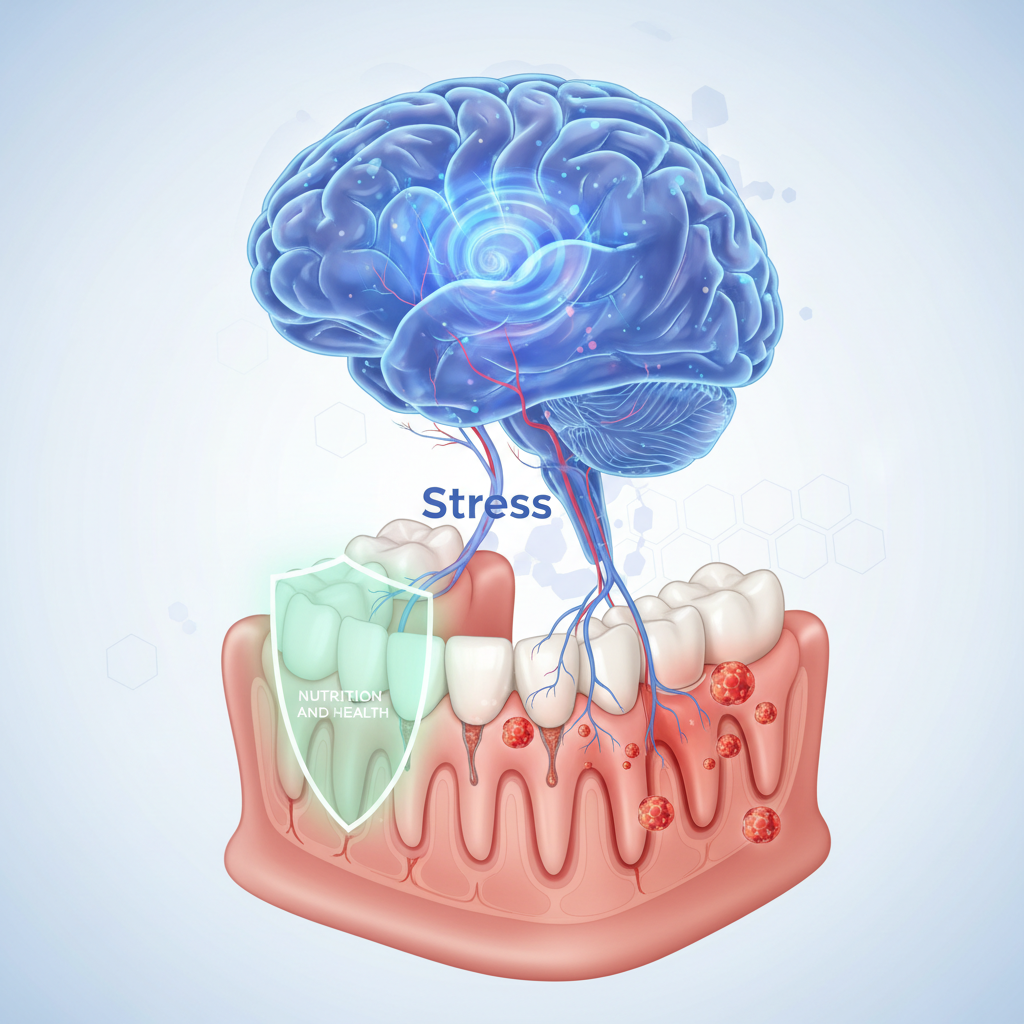
Die Studie – Was wurde untersucht und warum betrifft dich das?
Stell dir vor, du stehst unter Dauerdruck, die To-do-Liste wird länger und länger, und die Entspannung ist ein Fremdwort. Dein Körper reagiert darauf – vielleicht mit Kopfschmerzen, Schlafproblemen oder Magendrücken. Aber hättest du gedacht, dass chronischer Stress auch dein Zahnfleisch angreifen kann? Eine brandaktuelle Studie aus China und Neuseeland beleuchtet genau diesen faszinierenden Zusammenhang und zeigt, wie eng Psyche und Mundgesundheit miteinander verknüpft sind.
Forschende um Luo S. und Jin X. haben untersucht, wie chronischer psychologischer Stress die Parodontitis, eine schwere Form der Zahnfleischentzündung, verstärkt. Sie wollten herausfinden, welche Rolle dabei das Mikrobiom in unserem Mund und bestimmte Immunzellen spielen. Bislang war dieser komplexe Mechanismus noch weitgehend ein Rätsel.
Die Forschenden führten Experimente an Mäusen durch, die chronischem Stress ausgesetzt waren (sogenannter Restraint Stress). Gleichzeitig analysierten sie bei menschlichen Probanden den Zusammenhang zwischen depressiven Symptomen und der Schwere ihrer Parodontitis. Dabei konnten sie eine signifikante Korrelation zwischen depressiven Symptomen und einer ausgeprägteren Parodontitis feststellen. Diese klinischen Beobachtungen wurden durch ein verändertes Mundmikrobiom untermauert.
Ein entscheidendes Ergebnis der Studie war, dass die Übertragung von Stuhlproben von gestressten Mäusen auf keimfreie Mäuse ausreichte, um das verstärkte Parodontitis-Phänomen auszulösen. Das deutet darauf hin, dass das durch Stress veränderte Mikrobiom einen kausalen Einfluss auf die Krankheit hat. Durch metabolische Analysen identifizierten die Forschenden einen Mangel an Eicosapentaensäure (EPA) – einer wichtigen Omega-3-Fettsäure – bei gestressten Mäusen mit Parodontitis. Mechanistisch konnten sie zeigen, dass die Gabe von EPA die Parodontitis linderte, indem es den NF-κB-Signalweg unterdrückte und so die pro-entzündliche Polarisierung von M1-Makrophagen hemmte.
Diese Ergebnisse enthüllen eine neue Achse zwischen Darm und Mund, die durch Mikrobiota und Metaboliten unter Stress beeinflusst wird. Die Studie positioniert die Omega-3-Fettsäure EPA als vielversprechenden therapeutischen Ansatz zur Linderung von stressbedingten Entzündungskrankheiten.
Quelle: Luo S, Lou F, Yang P, et al. (2026). Dysregulation of Oral Microbial Eicosapentaenoic Acid Induced by Chronic Restraint Stress Exacerbates Periodontitis via M1 Macrophage Polarization. Advanced Science (Weinheim, Baden-Wurttemberg, Germany). PubMed-ID: 41783924
Was heisst das wirklich? – Die kritische Einordnung
Diese Studie ist ein spannendes Puzzleteil im Verständnis der komplexen Wechselwirkungen zwischen Psyche, Mikrobiom und Entzündungen. Sie liefert nicht nur eine Korrelation, sondern – zumindest im Tiermodell – Hinweise auf eine Kausalität. Die Übertragung des Mikrobioms von gestressten Mäusen auf keimfreie Mäuse, die dann ebenfalls eine verstärkte Parodontitis entwickelten, ist ein starkes Argument dafür, dass die Mikrobiota hier eine aktive Rolle spielt und nicht nur ein Begleiterscheinung ist.
Es ist wichtig zu verstehen, dass die Studie sowohl klinische Beobachtungen am Menschen (Korrelation zwischen depressiven Symptomen und Parodontitis) als auch detaillierte mechanistische Untersuchungen an Tiermodellen kombiniert. Letztere ermöglichen es, genau zu verfolgen, welche molekularen Pfade betroffen sind. Der Nachweis, dass EPA entzündungshemmend wirkt, indem es die M1-Makrophagen-Polarisierung hemmt, ist ein konkreter mechanistischer Einblick, der zukünftige Therapieansätze inspirieren könnte.
Allerdings dürfen wir nicht vergessen, dass ein Grossteil der mechanistischen Arbeit an Mäusen durchgeführt wurde. Auch wenn die Ergebnisse an Mäusen oft auf den Menschen übertragbar sind, gibt es physiologische Unterschiede. Die Dosis und Form von EPA, die bei Mäusen wirksam war, muss nicht zwingend 1:1 auf den Menschen übertragbar sein. Zudem ist die Korrelation zwischen depressiven Symptomen und Parodontitis beim Menschen zwar signifikant, aber Korrelation ist eben nicht Kausalität. Es kann viele Begleitfaktoren geben, die sowohl depressive Symptome als auch Parodontitis beeinflussen, wie zum Beispiel Ernährungsgewohnheiten, Rauchen oder mangelnde Mundhygiene, die in dieser Studie nicht vollständig kontrolliert wurden.
Was bedeutet „statistisch signifikant“ in diesem Kontext? Es bedeutet, dass die beobachteten Unterschiede oder Zusammenhänge unwahrscheinlich durch Zufall entstanden sind. Für dich als Einzelperson heisst das aber nicht automatisch, dass du, sobald du gestresst bist, sofort eine schwere Parodontitis entwickelst. Jeder Mensch reagiert anders, und viele Faktoren spielen eine Rolle. Die Studie zeigt einen Mechanismus auf, der relevant sein kann, aber nicht zwingend in jedem Fall die volle Ausprägung findet.
Denkwerkzeug: Wenn du selbst unter Stress stehst oder depressive Symptome hast, frage dich: Wie steht es um meine Mundgesundheit? Achte ich auf regelmässige Kontrollen und gute Mundhygiene? Könnte mein Stresslevel ein Faktor sein, den ich bisher unterschätzt habe?
Der Geist im Körper – Die psychophysiologische Perspektive
Hier zeigt sich das psychophysiologische Interaktionsmodell in seiner ganzen Tragweite. Diese Studie ist ein Paradebeispiel dafür, wie psychischer Stress nicht nur „im Kopf“ bleibt, sondern tiefgreifende physiologische Veränderungen im gesamten Körper auslösen kann – bis hin zu unserem Mundmikrobiom und der Entzündungsreaktion im Zahnfleisch. Stress ist keine abstrakte Laune der Natur; er ist ein mächtiger Regulator unserer Biologie.
Chronischer Stress, wie er im Tiermodell simuliert wurde, oder depressive Symptome, wie sie bei den menschlichen Probanden beobachtet wurden, aktivieren die Stressachse (HPA-Achse) und das sympathische Nervensystem. Das führt zu einer Ausschüttung von Stresshormonen wie Cortisol und Adrenalin. Diese Hormone können direkt und indirekt das Immunsystem beeinflussen, Entzündungsprozesse fördern und – wie diese Studie nahelegt – sogar die Zusammensetzung und Funktion unseres Mikrobioms verändern.
Die Dysregulation des oralen Mikrobioms unter Stress und der Mangel an EPA sind keine Zufallsprodukte. Es ist gut denkbar, dass chronischer Stress die Darmbarriere beeinträchtigt, die Nährstoffaufnahme verändert oder den Stoffwechsel so umstellt, dass weniger entzündungshemmende Substanzen wie EPA zur Verfügung stehen. Gleichzeitig kann ein verändertes Mikrobiom selbst die Entzündungsbereitschaft des Körpers erhöhen und die Immunantwort modulieren. Es entsteht ein Teufelskreis: Stress verändert das Mikrobiom, das Mikrobiom fördert Entzündungen, und diese Entzündungen können wiederum die Stresswahrnehmung verstärken.
Diese Studie erinnert uns daran, dass Mundgesundheit weit mehr ist als nur Zähneputzen. Unser Mund ist ein Spiegel unserer inneren Welt. Die Überzeugungen, Emotionen und der Stress, den wir erleben, manifestieren sich in unserer Physiologie. Wer glaubt, dass Stress ihn krank macht, könnte tatsächlich anfälliger sein, nicht nur wegen einer Nocebo-Wirkung, sondern weil die psychische Belastung reale physiologische Kaskaden in Gang setzt, die bis ins Zahnfleisch reichen.
Der grössere Kontext – Einordnung und Abhängigkeiten
Diese Studie fügt sich gut in die wachsende Erkenntnis ein, dass der Zusammenhang zwischen Psyche, Mikrobiom und Entzündungen eine zentrale Rolle für unsere Gesundheit spielt. Die Idee einer „Darm-Hirn-Achse“ ist schon länger etabliert, aber diese Forschung erweitert das Konzept um eine „Stress-Mikrobiom-Mund-Achse“. Es ist ein Puzzleteil, das die Komplexität der Wechselwirkungen aufzeigt.
Die Studie wurde von Forschenden aus China und Neuseeland durchgeführt und in „Advanced Science“ veröffentlicht, einem renommierten Journal. Die Autoren geben keine spezifischen Interessenkonflikte an, was die Glaubwürdigkeit der Ergebnisse stärkt. Die Finanzierung erfolgte durch verschiedene chinesische Forschungsprogramme und Stiftungen.
Was in dieser Studie nicht vollständig kontrolliert werden konnte, sind die unzähligen anderen Lebensstilfaktoren, die sowohl Stress als auch Parodontitis beeinflussen. Zum Beispiel: Wie ernähren sich die gestressten Probanden? Rauchen sie mehr? Pflegen sie ihre Zähne schlechter? Schlafen sie weniger? All diese Faktoren können die Ergebnisse beeinflussen und müssten in zukünftigen, umfassenderen Humanstudien stärker berücksichtigt werden. Es ist wichtig zu erkennen, dass die Studie einen spezifischen Mechanismus beleuchtet, aber nicht alle Aspekte der Krankheitsentstehung abdeckt.
Denkwerkzeug: Wenn du überlegst, aufgrund dieser Studie dein Verhalten zu ändern, frage dich: Passt das Ergebnis zu dem, was ich bereits über meinen Körper und meinen Lebensstil weiss? Gibt es andere Faktoren in meinem Leben, die meine Mundgesundheit und mein Stresslevel beeinflussen könnten und die ich zuerst angehen sollte?
Was heisst das für dich? – Fazit und Alltagsrelevanz
Diese Studie liefert dir wichtige Impulse, wie du deine Gesundheit ganzheitlich betrachten kannst. Hier sind 2–3 konkrete Erkenntnisse, die du mitnehmen kannst:
- Stressmanagement ist Mundhygiene: Die Studie unterstreicht eindrücklich, dass die Pflege deiner psychischen Gesundheit genauso wichtig für dein Zahnfleisch sein kann wie das tägliche Zähneputzen. Chronischer Stress ist ein Risikofaktor für Parodontitis. Überlege, welche Stressbewältigungsstrategien du in deinen Alltag integrieren kannst – sei es Meditation, Achtsamkeitsübungen, Sport oder einfach mehr Zeit für Entspannung.
- Omega-3-Fettsäuren im Fokus: Die identifizierte Rolle von EPA ist faszinierend. Wenn du unter Stress stehst oder zu Entzündungen neigst, könnte eine ausreichende Zufuhr von Omega-3-Fettsäuren (insbesondere EPA) über die Ernährung (fettreicher Fisch wie Lachs, Makrele, Hering) oder hochwertige Nahrungsergänzungsmittel sinnvoll sein. Besprich dies aber immer mit deinem Arzt oder einem qualifizierten Ernährungsberater, um die richtige Dosierung für dich zu finden.
- Achte auf dein Mikrobiom: Auch wenn die Studie sich auf das orale Mikrobiom konzentriert, ist die Gesundheit deines Darmmikrobioms eng damit verbunden. Eine vielfältige, ballaststoffreiche Ernährung, die präbiotische und probiotische Lebensmittel enthält, kann dein Mikrobiom unterstützen und somit indirekt auch deine Mundgesundheit und deine Stressresilienz fördern.
Was du NICHT daraus schliessen solltest: Nur weil du gestresst bist, ist deine Parodontitis unvermeidlich. Diese Studie zeigt einen möglichen Mechanismus auf, aber sie ist kein Schicksalsurteil. Sie ist vielmehr eine Einladung, proaktiv zu werden und die Zusammenhänge zu verstehen. Auch solltest du nicht allein auf EPA als Wundermittel setzen, ohne die zugrunde liegenden Stressfaktoren anzugehen oder deine Mundhygiene zu vernachlässigen.
Diese Erkenntnisse sind besonders relevant für Menschen, die unter chronischem Stress leiden, depressive Symptome zeigen oder immer wieder mit Zahnfleischentzündungen zu kämpfen haben. Für diejenigen, die bereits ein gutes Stressmanagement und eine robuste Mundgesundheit haben, bestätigt sie vielleicht die Wichtigkeit eines ganzheitlichen Ansatzes.
Vergiss nie: Dein Körper reagiert nicht nur auf das, was du isst oder wie du dich bewegst – sondern auch auf das, was du denkst und fühlst. Die Verbindung zwischen deinem Geist und deinem Körper ist real und messbar, bis in die kleinsten Winkel deiner Mundhöhle. Nimm diese Verbindung ernst und nutze sie, um deine Gesundheit aktiv zu gestalten. Bleibe neugierig auf die Signale deines Körpers und experimentiere achtsam mit dem, was dir guttut.
Wissenschaftliche Quelle
Advanced science (Weinheim, Baden-Wurttemberg, Germany)