Zucker, Darm und Schleimschicht: Wie unsere Ernährung die Darmbarriere formt
Eine neue Übersichtsarbeit beleuchtet, wie die feinen Strukturen von Polysacchariden – den komplexen Kohlenhydraten in unserer Nahrung – die Darmmikrobiota und die schützende Schleimschicht im Darm beeinflussen. Erfahre, wie diese unsichtbaren Prozesse deine Darmgesundheit prägen.
Die Studie – Was wurde untersucht und warum betrifft dich das?
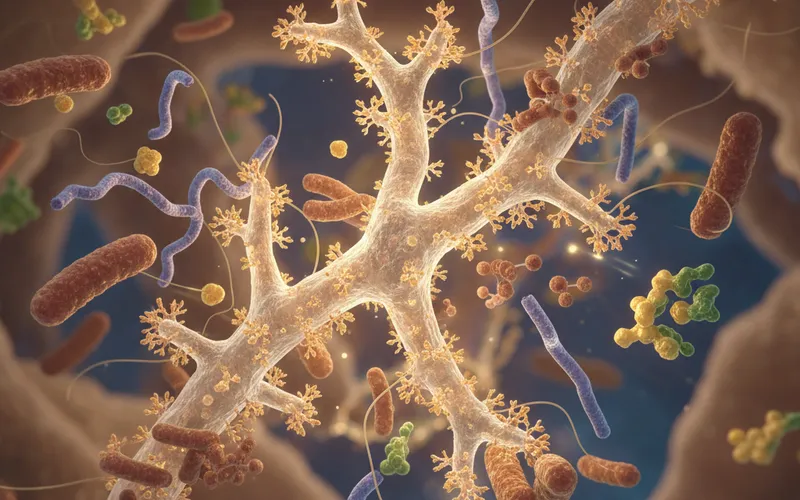
Stell dir vor, dein Darm ist eine Festung. Eine extrem wichtige Festung, denn hier wird entschieden, was in deinen Körper gelangt und was draussen bleibt. Die erste Verteidigungslinie dieser Festung ist eine schleimige Schutzschicht, die sogenannte Mukusschicht. Sie ist nicht nur eine passive Barriere, sondern ein lebendiger, dynamischer Teppich, der ständig erneuert und von Milliarden von Bakterien besiedelt wird. Wie gut diese Schutzschicht funktioniert, hängt entscheidend davon ab, wie sie aufgebaut ist – und genau hier kommen Polysaccharide ins Spiel.
Eine aktuelle Übersichtsarbeit von Forschenden der Shangluo University in China, unter der Leitung von T. Zhao und X. Liang, hat sich genau diesem komplexen Zusammenspiel gewidmet. Sie haben untersucht, wie die feinen strukturellen Merkmale von Polysacchariden – das sind komplexe Kohlenhydrate, die wir über die Nahrung aufnehmen – die Darmmikrobiota beeinflussen und wie diese wiederum die Bildung der Mukusschicht (genauer gesagt die Mucin-O-Glykosylierung) mitgestalten. Die Studie wurde im Journal Carbohydrate Polymers veröffentlicht und fasst den aktuellen Forschungsstand zusammen, um zu verstehen, wie unsere Ernährung auf molekularer Ebene unsere Darmgesundheit beeinflusst.
Die zentrale Fragestellung war: Wie genau wirken die verschiedenen Arten von Polysacchariden auf unsere Darmbakterien und deren Fähigkeit, die schützende Schleimschicht zu modulieren? Die Forschenden analysierten, wie die Zusammensetzung von Monosacchariden, die Art der glykosidischen Bindungen, das Molekulargewicht, die Verzweigungsmuster und chemische Modifikationen von Polysacchariden die Kolonisierung und den Stoffwechsel der Darmmikroben beeinflussen. Diese Mikroben produzieren dann wiederum Metaboliten wie kurzkettige Fettsäuren (SCFAs) und Gallensäuren, die die Expression von Glykosyltransferasen im Wirt regulieren. Glykosyltransferasen sind Enzyme, die für den Umbau der Mucin-O-Glykane – also der Zuckerketten auf den Schleimproteinen – verantwortlich sind. Darüber hinaus wurde die Rolle bakterieller Glykosidasen (wie Fucosidasen und Sialidasen) beleuchtet, die die Struktur der Mukusschicht dynamisch verändern und somit deren Eigenschaften und die Anhaftung von Mikroben beeinflussen. Die Autoren untersuchten auch Krankheitsmodelle, um zu zeigen, wie eine gestörte Mucin-Remodellierung bei Erkrankungen wie entzündlichen Darmerkrankungen (IBD) oder Allergien auftritt.
Diese Arbeit ist eine sogenannte Review-Studie, was bedeutet, dass die Autoren keine neuen Experimente durchgeführt, sondern eine Vielzahl bestehender Studien systematisch zusammengetragen und analysiert haben. Sie fasst also das Wissen vieler einzelner Untersuchungen zusammen, um ein umfassendes Bild zu zeichnen. Die Autoren stammen alle von der Shangluo University in China.
Quelle: Zhao T, Zhang B, Hu X, Jia F, Zheng Q, Lu T, Tan S, Lang W, He N, Liang X (2026). Fine structural features of polysaccharides and gut microbiota Co-regulate mucin O-glycosylation: Mechanisms and advances. Carbohydrate Polymers, 380. PubMed-ID: 41831943
Was heisst das wirklich? – Die kritische Einordnung
Diese Übersichtsarbeit ist ein wertvoller Beitrag, weil sie die ungeheure Komplexität des Darms und die Bedeutung feinster Details in unserer Ernährung aufzeigt. Sie bestätigt auf molekularer Ebene, was wir intuitiv wissen: Was wir essen, ist entscheidend für unsere Darmgesundheit. Doch was bedeutet diese Komplexität für dich, den Einzelnen?
Die Studie betont die «feinen strukturellen Merkmale» von Polysacchariden. Das ist wichtig, denn es heisst, dass nicht einfach «Ballaststoffe» gut sind, sondern dass es auf die genaue Art der Ballaststoffe ankommt. Eine Karotte ist nicht gleich eine Apfelschale, und auch innerhalb dieser Lebensmittel gibt es unzählige Variationen in der Zuckerstruktur. Das erklärt, warum manche Menschen auf bestimmte Ballaststoffe besser reagieren als andere.
Ein weiterer wichtiger Punkt ist die Betonung der kurzkettigen Fettsäuren (SCFAs) wie Butyrat, Propionat und Acetat. Diese werden von Darmbakterien produziert, wenn sie Polysaccharide fermentieren, und sind bekannt für ihre positiven Effekte auf die Darmbarriere und Entzündungshemmung. Die Studie zeigt, dass SCFAs die Genexpression von Glykosyltransferasen beeinflussen und somit direkt die Zusammensetzung der Mukusschicht mitgestalten. Das ist ein harter Endpunkt, da SCFAs direkt gemessen werden können und ihre Wirkmechanismen gut erforscht sind.
Als Review-Studie hat diese Arbeit den Vorteil, ein breites Spektrum an Wissen zu bündeln und Zusammenhänge aufzuzeigen, die in Einzelstudien oft im Verborgenen bleiben. Die Autoren haben eine beeindruckende Menge an Forschung integriert. Die Grenzen liegen jedoch darin, dass eine Review-Studie immer nur so gut ist wie die ihr zugrundeliegenden Einzelstudien. Sie kann Schwächen in den Originalarbeiten nicht ausgleichen und liefert selbst keine neuen experimentellen Daten.
Für wen gelten die Ergebnisse? Die Erkenntnisse sind grundsätzlich für jeden relevant, der sich für Darmgesundheit interessiert. Allerdings zeigt die Studie auch, dass bei Krankheiten wie IBD die Mechanismen der Mucin-Remodellierung unterschiedlich sein können. Was bei einem gesunden Darm funktioniert, muss nicht eins zu eins auf einen kranken Darm übertragbar sein.
Denkwerkzeug: Wenn du das nächste Mal von «Ballaststoffen» hörst, frage dich: Geht es hier um spezifische Ballaststoffe mit bekannten Wirkungen, oder ist es eine Verallgemeinerung, die die wichtige Vielfalt und die feinen strukturellen Unterschiede übersieht, die diese Studie hervorhebt?
Der Geist im Körper – Die psychophysiologische Perspektive
Die Studie beleuchtet beeindruckend die molekularen Mechanismen, wie Polysaccharide und Darmmikroben die Mukusschicht formen. Was sie jedoch – wie die meisten Studien dieser Art – nicht explizit thematisiert, ist die alles entscheidende psychophysiologische Dimension. Dein Darm ist nicht nur ein Verdauungsorgan, er ist ein sensibles Organ, das eng mit deinem Gehirn verbunden ist – über die sogenannte Darm-Hirn-Achse.
Stell dir vor, du bist gestresst. Chronischer Stress hat massive Auswirkungen auf deinen Darm. Er kann die Motilität verändern, die Durchblutung beeinflussen und – ganz wichtig in diesem Kontext – die Zusammensetzung deiner Darmmikrobiota verschieben. Ein gestresster Darm ist ein idealer Nährboden für Dysbiosen. Diese Dysbiose wiederum kann die Produktion der kurzkettigen Fettsäuren (SCFAs) beeinträchtigen, die in der Studie so prominent als Modulatoren der Mukusschicht genannt werden.
Es ist gut denkbar, dass Stress nicht nur die Bakterien direkt beeinflusst, sondern auch die Fähigkeit deines Körpers, die von den Bakterien produzierten Metaboliten zu nutzen. Wenn dein Körper im Kampf-oder-Flucht-Modus ist, hat der Aufbau einer robusten Darmschleimschicht keine Priorität. Die Energie wird für andere Prozesse benötigt. Deine Erwartungen und Überzeugungen spielen ebenfalls eine Rolle. Wenn du überzeugt bist, dass eine gesunde Ernährung deine Darmgesundheit fördert, wirst du wahrscheinlich nicht nur bewusster essen, sondern auch ein positives physiologisches Feedback erleben. Das ist der Nocebo-Effekt im positiven Sinne, der Placebo-Effekt.
Der Hawthorne-Effekt, bei dem Menschen ihr Verhalten ändern, wenn sie wissen, dass sie beobachtet werden, ist hier ebenfalls relevant. Wenn du anfängst, dich bewusster mit deiner Ernährung auseinanderzusetzen, weil du die Zusammenhänge verstehst, beeinflusst allein dieses Bewusstsein schon dein Verhalten und somit indirekt deine Darmgesundheit. Deine Psyche ist kein passiver Beobachter, sondern ein aktiver Mitgestalter deiner Darmphysiologie, selbst auf dieser feinstofflichen Ebene der Mucin-Glykosylierung.
Der grössere Kontext – Einordnung und Abhängigkeiten
Diese Übersichtsarbeit ordnet sich gut in den aktuellen Forschungsstand zur Darmgesundheit ein, der zunehmend die Bedeutung der Mikrobiota und ihrer Interaktion mit dem Wirt hervorhebt. Sie bestätigt und vertieft unser Verständnis, dass die Darmmikrobiota nicht nur ein passiver Bewohner ist, sondern aktiv in die Physiologie des Wirts eingreift, indem sie zum Beispiel die Schleimschicht remodelliert.
Die Studie wurde von Forschenden der Shangluo University durchgeführt, und es wurden keine Interessenkonflikte deklariert, was die Glaubwürdigkeit der Ergebnisse stärkt. Die Finanzierung ist in solchen Fällen oft universitätsintern oder durch öffentliche Forschungsgelder gesichert, was eine unabhängige Forschungstätigkeit vermuten lässt.
Was in dieser Studie nicht direkt kontrolliert werden konnte – da es sich um eine Review-Studie handelt, die bestehende Daten analysiert – sind die unzähligen anderen Lebensstilfaktoren, die die Darmgesundheit beeinflussen. Schlafqualität, Bewegung, Stresslevel, Medikamenteneinnahme, Umwelttoxine – all diese Faktoren spielen eine Rolle und können die Zusammensetzung der Mikrobiota und damit auch die Mucin-O-Glykosylierung beeinflussen. Eine einzelne Studie kann unmöglich alle diese Variablen berücksichtigen, aber es ist wichtig, sich dieser Komplexität bewusst zu sein.
Diese Arbeit ist ein wichtiges Puzzleteil, das uns hilft, die molekularen Details der Darmgesundheit besser zu verstehen. Sie ist jedoch keine Revolution, sondern eine Bestätigung und Vertiefung bestehender Erkenntnisse. Sie unterstreicht die Wichtigkeit einer ballaststoffreichen Ernährung, differenziert aber gleichzeitig, dass es auf die Qualität und Art der Ballaststoffe ankommt. Es ist ein Aufruf zu mehr Präzision in der Ernährungsforschung.
Denkwerkzeug: Wenn dir jemand eine neue Diät oder ein neues Supplement für den Darm empfiehlt, frage dich: Berücksichtigt diese Empfehlung die feinen strukturellen Unterschiede von Nahrungsmitteln und die individuelle Zusammensetzung der Darmmikrobiota, oder ist es eine pauschale Aussage, die der Komplexität, die diese Studie aufzeigt, nicht gerecht wird?
Was heisst das für dich? – Fazit und Alltagsrelevanz
Was kannst du aus dieser hochkomplexen Studie für deinen Alltag mitnehmen? Erstens: Die Vielfalt zählt. Nicht nur die Menge an Ballaststoffen, sondern die Vielfalt der Polysaccharide in deiner Ernährung ist entscheidend. Versuche, eine breite Palette an pflanzlichen Lebensmitteln zu essen – verschiedene Gemüse-, Obst-, Hülsenfrucht- und Vollkornsorten. Jede Pflanze bringt ihre eigenen einzigartigen Polysaccharide mit, die unterschiedliche Bakterienstämme füttern und so eine robuste, vielfältige Mikrobiota fördern.
Zweitens: Höre auf deinen Darm. Da die Reaktion auf bestimmte Polysaccharide so individuell ist, ist es wichtig, dass du auf die Signale deines Körpers achtest. Wenn ein Lebensmittel dir guttut, integriere es. Wenn es dir Beschwerden bereitet, reduziere es oder lasse es weg. Dein Darm ist dein bester Berater.
Drittens: Unterschätze niemals den Einfluss deines Geistes. Auch wenn diese Studie sich auf molekulare Mechanismen konzentriert, ist es dein Stresslevel, deine innere Einstellung und deine emotionale Balance, die massgeblich mitbestimmen, wie gut dein Darm diese wertvollen Nährstoffe verarbeiten und eine gesunde Schleimschicht aufbauen kann. Eine entspannte Mahlzeit, bewusst und mit Genuss eingenommen, kann physiologisch einen grossen Unterschied machen – weit über die reine Nährstoffaufnahme hinaus.
Was solltest du NICHT daraus schliessen? Kaufe jetzt nicht blind irgendwelche Polysaccharid-Supplemente. Die Forschung ist noch lange nicht so weit, dass wir präzise sagen können, welche spezifischen Polysaccharide für wen am besten sind. Eine ausgewogene, natürliche Ernährung ist immer die beste Wahl. Auch wenn die Studie therapeutische Interventionen mit glykan-gezielten Präbiotika vorschlägt, ist dies Zukunftsmusik und sollte nicht als Aufforderung verstanden werden, jetzt auf eigene Faust zu experimentieren.
Diese Erkenntnisse sind besonders relevant für Menschen mit Darmbeschwerden oder chronischen Entzündungen, aber auch für jeden, der seine allgemeine Gesundheit und sein Wohlbefinden optimieren möchte. Denn ein gesunder Darm ist die Basis für einen gesunden Körper und einen klaren Geist.
Die Forschung zeigt uns immer wieder, wie eng Körper und Geist miteinander verwoben sind. Dein Darm reagiert nicht nur auf das, was du isst, sondern auch auf das, was du denkst und fühlst. Das ist die Essenz des psychophysiologischen Interaktionsmodells. Welche Fragen bleiben offen? Die präzise Entwicklung personalisierter Ernährungsstrategien auf Basis der individuellen Mikrobiota und Genetik ist noch ein weites Feld. Es wird spannend zu sehen sein, wie wir in Zukunft noch gezielter unsere Darmgesundheit beeinflussen können.
Bleib neugierig, höre auf deinen Körper und vergiss nie: Du bist der wichtigste Faktor in deiner eigenen Gesundheitsgleichung.