Omega-3: Ein Hoffnungsschimmer für Knochen und Leber bei Leberschäden
Eine aktuelle Studie zeigt, wie Omega-3-Fettsäuren bei Leberschäden sowohl Knochenabbau entgegenwirken als auch die Leberfunktion verbessern können. Ein spannender Blick auf die Verbindung zwischen Leber und Knochen.
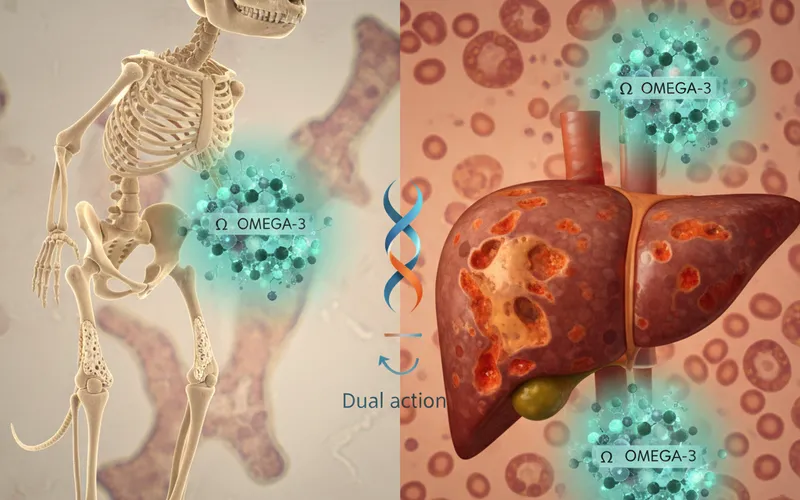
Die Studie – Was wurde untersucht und warum betrifft dich das?
Stell dir vor, deine Leber und deine Knochen, zwei scheinbar unabhängige Organe, sind enger miteinander verbunden, als du vielleicht denkst. Diese Verbindung, oft als «Leber-Knochen-Achse» bezeichnet, spielt eine entscheidende Rolle für deine Gesundheit. Wenn die Leber leidet, können auch die Knochen darunter leiden – ein Zustand, der als hepatische Osteodystrophie (HOD) bekannt ist. Besonders betroffen sind Menschen mit einer nicht-alkoholischen Fettleber (NAFLD), einer immer häufiger werdenden Erkrankung, die oft unbemerkt bleibt, aber weitreichende Folgen haben kann.
Genau diesem komplexen Zusammenspiel widmete sich eine aktuelle Studie von Forschenden aus China, angeführt von J. Huang und Kollegen. Publiziert wurde die Untersuchung im renommierten Fachjournal Food & Function. Ihr zentrales Anliegen war es, die Mechanismen hinter der hepatischen Osteodystrophie zu verstehen und mögliche therapeutische Ansätze zu finden. Insbesondere konzentrierten sie sich auf die Rolle von Omega-3-Fettsäuren.
Die Forschenden arbeiteten mit einem Rattenmodell, das die menschliche hepatische Osteodystrophie nachbildet. Sie untersuchten, wie eine Störung des sogenannten reversen Cholesterintransports – ein wichtiger Prozess, bei dem Cholesterin aus den Zellen zur Leber transportiert wird – zu einer abnormalen Cholesterinansammlung in den Knochen führt. Diese Ansammlung behindert die Neubildung von Knochengewebe und fördert den Knochenabbau.
Ihre Hypothese war, dass Omega-3-Fettsäuren, bekannt für ihre positiven Effekte auf den Stoffwechsel, diesen gestörten Cholesterintransport verbessern und somit sowohl den Knochen als auch der Leber zugutekommen könnten. Die Ergebnisse der Studie zeigten tatsächlich, dass die Verabreichung von Omega-3-Fettsäuren im Rattenmodell das Lipidstoffwechsels verbesserte, indem sie den peripheren reversen Cholesterintransport förderten. Dies führte zu einer Reduktion der übermässigen Cholesterinansammlung in den Knochen, einer Verbesserung des Knochenmikromilieus und letztlich zu einer Linderung des Knochenabbaus und einer Verringerung der Leberschäden.
Quelle: Huang J, Chen L, Yu H, Zhou S, Guan J, Xu C (2026). Dual improvement effects of ω-3 on bone loss and liver injury in rats with liver-bone axis damage. Food & function. PubMed-ID: 41834729
Was heisst das wirklich? – Die kritische Einordnung
Die Ergebnisse dieser Studie sind spannend und vielversprechend, aber es ist wichtig, sie richtig einzuordnen. Zunächst einmal handelt es sich um eine präklinische Studie an Ratten. Obwohl Tiermodelle wertvolle Einblicke in biologische Prozesse liefern, lassen sich die Ergebnisse nicht eins zu eins auf den Menschen übertragen. Was bei Ratten funktioniert, muss nicht zwangsläufig auch bei uns die gleiche Wirkung zeigen. Der menschliche Stoffwechsel ist komplexer und wird von vielen weiteren Faktoren beeinflusst.
Die Studie identifiziert klar den gestörten Cholesterintransport als zentralen Mechanismus bei der hepatischen Osteodystrophie. Die Verbesserung dieses Transports durch Omega-3-Fettsäuren ist ein starkes Argument für ihre potenzielle Rolle. Allerdings wurden hier Surrogatparameter gemessen – also Marker, die auf eine Verbesserung hindeuten, aber nicht direkt klinische Endpunkte wie eine reduzierte Frakturrate oder eine vollständige Heilung der Fettleber darstellen. Ein verbesserter Lipidstoffwechsel ist zwar ein wichtiger Schritt, aber noch kein Beweis für eine langfristige Gesundheitsverbesserung im menschlichen Alltag.
Methodisch ist die Studie gut gemacht für ein Tiermodell. Die Forschenden konnten die molekularen Mechanismen aufzeigen, was das Verständnis der Leber-Knochen-Achse vertieft. Dennoch bleiben Fragen offen: Welche Dosen an Omega-3 wären beim Menschen wirksam? Wie lange müsste die Einnahme erfolgen? Und welche spezifischen Omega-3-Fettsäuren (EPA, DHA oder eine Kombination) wären am besten geeignet?
Denkwerkzeug: Wenn du von Studienergebnissen hörst, die an Tieren gewonnen wurden, frage dich immer: Wie gross ist der Schritt vom Labor zum menschlichen Körper? Welche anderen Faktoren könnten die Ergebnisse beim Menschen beeinflussen, die im Tiermodell nicht berücksichtigt wurden?
Der Geist im Körper – Die psychophysiologische Perspektive
Die Studie beleuchtet die biochemischen Prozesse der Leber-Knochen-Achse, lässt aber einen entscheidenden Aspekt aussen vor, der gerade bei chronischen Erkrankungen wie der nicht-alkoholischen Fettleber eine immense Rolle spielt: die psychophysiologische Interaktion. Eine Fettleber ist oft das Ergebnis eines komplexen Zusammenspiels von Ernährung, Bewegung, aber eben auch von Stress, Schlaf und emotionaler Verfassung. Dein Körper reagiert nicht nur auf das, was du isst, sondern auch auf das, was du denkst und fühlst.
Chronischer Stress beispielsweise führt zu einer erhöhten Ausschüttung von Stresshormonen wie Cortisol. Cortisol wiederum beeinflusst den gesamten Stoffwechsel, kann die Insulinsensitivität verringern, Entzündungsprozesse fördern und sich negativ auf den Lipidstoffwechsel auswirken – all das sind Faktoren, die zur Entstehung und Verschlimmerung einer Fettleber beitragen können. Auch die Knochen sind davon betroffen, da chronischer Stress den Knochenabbau fördern kann.
Es ist gut denkbar, dass die Wirksamkeit von Omega-3-Fettsäuren – oder jeder anderen therapeutischen Intervention – massgeblich von der psychischen Verfassung des Individuums abhängt. Wer unter chronischem Stress steht, schlecht schläft oder sich emotional belastet fühlt, hat möglicherweise eine andere Ausgangslage und reagiert anders auf Nahrungsergänzungsmittel als jemand, der psychisch stabil ist. Die Überzeugung, etwas Gutes für sich zu tun (Placebo-Effekt), kann die Wirkung zusätzlich verstärken, während Skepsis (Nocebo-Effekt) sie abschwächen könnte.
Die Studie misst harte physiologische Parameter, doch die psychische Komponente als potenzieller Confounder – der die Ergebnisse beeinflussen könnte – wird hier nicht berücksichtigt. Dies ist keine Kritik an der Studie selbst, da solche Faktoren in Tiermodellen schwer zu erfassen sind, aber es ist ein wichtiger Gedanke für die Übertragung auf den Menschen.
Der grössere Kontext – Einordnung und Abhängigkeiten
Diese Studie reiht sich in eine wachsende Zahl von Untersuchungen ein, die die vielfältigen positiven Wirkungen von Omega-3-Fettsäuren auf den menschlichen Körper belegen. Insbesondere die entzündungshemmenden Eigenschaften und die Verbesserung des Lipidstoffwechsels sind gut dokumentiert. Die spezifische Verbindung zur Leber-Knochen-Achse bei hepatischer Osteodystrophie ist jedoch ein vergleichsweise neues und spannendes Forschungsfeld.
Die Finanzierung und die Affiliation der Autoren – mit dem Department für Orthopädie und dem Key Laboratory of Anhui Province for Tissue Transplantation – deuten auf ein legitimes wissenschaftliches Interesse an Knochengesundheit und Regeneration hin. Es sind keine offensichtlichen Interessenkonflikte ersichtlich, die die Glaubwürdigkeit der Ergebnisse schmälern würden.
Was in dieser Studie nicht kontrolliert wurde, sind die vielen anderen Lebensstilfaktoren, die sowohl die Leber- als auch die Knochengesundheit massgeblich beeinflussen. Ernährungsgewohnheiten jenseits der Omega-3-Zufuhr, körperliche Aktivität, Rauchen, Alkoholkonsum, die Einnahme von Medikamenten oder das Vorhandensein anderer chronischer Erkrankungen – all das spielt eine Rolle. Eine einzelne Studie kann und muss nicht alles abdecken, aber es ist wichtig zu verstehen, dass die Wirkung von Omega-3 im Kontext eines komplexen Lebensstils stattfindet.
Denkwerkzeug: Wenn du eine Studie liest, die eine einzelne Substanz oder Massnahme hervorhebt, frage dich: Welche anderen Faktoren in meinem Leben könnten die Wirkung dieser Substanz verstärken oder abschwächen? Bin ich bereit, auch diese Faktoren zu optimieren, um die bestmöglichen Ergebnisse zu erzielen?
Was heisst das für dich? – Fazit und Alltagsrelevanz
Was kannst du aus dieser vielversprechenden, aber noch im präklinischen Stadium befindlichen Studie für deinen Alltag mitnehmen?
- Omega-3-Fettsäuren sind wertvoll: Die Studie untermauert einmal mehr die vielfältigen positiven Effekte von Omega-3-Fettsäuren. Auch wenn die direkten Effekte auf die Leber-Knochen-Achse beim Menschen noch weiter erforscht werden müssen, ist eine ausreichende Zufuhr von Omega-3 (z.B. über fettreichen Fisch, Leinsamen oder hochwertige Nahrungsergänzungsmittel) für die allgemeine Gesundheit, insbesondere für Herz-Kreislauf und Entzündungsregulation, unbestritten vorteilhaft.
- Die Leber-Knochen-Verbindung beachten: Die Studie erinnert uns daran, dass der Körper kein Konglomerat unabhängiger Systeme ist, sondern ein komplexes Netzwerk. Probleme in einem Bereich (wie der Leber) können weitreichende Folgen für andere Bereiche (wie die Knochen) haben. Dies ist besonders relevant, wenn du bereits an einer Fettleber leidest oder Risikofaktoren dafür hast.
- Nicht nur auf ein Wundermittel setzen: Auch wenn Omega-3 vielversprechend ist, solltest du nicht erwarten, dass es allein alle Probleme löst. Eine gesunde Leber und starke Knochen erfordern einen ganzheitlichen Ansatz, der eine ausgewogene Ernährung, regelmässige Bewegung, ausreichend Schlaf und effektives Stressmanagement umfasst.
Was du daraus nicht schliessen solltest, ist, dass eine hohe Dosis Omega-3 automatisch deine Leber heilt oder deinen Knochenabbau stoppt. Die Forschung ist hier noch am Anfang, und die optimalen Dosen und Anwendungsformen für spezifische Krankheitsbilder beim Menschen sind noch nicht geklärt. Eine eigenmächtige Hochdosistherapie ist daher nicht ratsam und sollte immer mit einem Arzt besprochen werden.
Die Ergebnisse sind besonders relevant für Menschen, die bereits an einer nicht-alkoholischen Fettleber (NAFLD) leiden oder ein erhöhtes Risiko dafür haben, sowie für alle, die ihre Knochengesundheit proaktiv unterstützen möchten. Für gesunde Menschen ohne spezifische Risikofaktoren bleibt die Empfehlung, auf eine ausgewogene Ernährung mit ausreichender Omega-3-Zufuhr zu achten.
Vergiss nicht: Dein Körper ist ein Wunderwerk der Interaktion. Was du isst, wie du dich bewegst, wie du schläfst und wie du mit Stress umgehst – all das beeinflusst nicht nur einzelne Organe, sondern das gesamte System. Die Gesundheit deiner Leber und deiner Knochen ist ein Spiegelbild deines gesamten Lebensstils.
Bleibt zu hoffen, dass weitere humane Studien die vielversprechenden Ergebnisse aus diesem Rattenmodell bestätigen und uns noch tiefere Einblicke in die therapeutischen Möglichkeiten von Omega-3-Fettsäuren geben werden. Bis dahin: Bleib neugierig, hör auf deinen Körper und pflege ihn ganzheitlich.