Bioelectrical Impedance Analysis (BIA): More Than Just Fat – A Psychophysiological Perspective on Body Composition
Bioelectrical Impedance Analysis (BIA) is a popular tool for estimating body fat, muscle mass, and body water. It measures the electrical resistance of the body to infer the distribution of these components. However, in the practice of Jürg Hösli, the founder of the psychophysiological interaction model, the consideration of BIA goes far beyond these basic measurements, offering a profound insight into the connections between psyche and body.
Bioelectrical Impedance Analysis (BIA): More Than Just Fat – A Psychophysiological Perspective on Body Composition
Bioelectrical Impedance Analysis (BIA) has established itself as a popular and accessible tool for estimating body fat, muscle mass, and body water. It measures the electrical resistance of the body to infer the distribution of these components. However, in the practice of Jürg Hösli, the founder of the psychophysiological interaction model, the consideration of BIA goes far beyond mere numbers. It becomes a puzzle piece that must be interpreted in the context of the individual's psychophysiological state. This article sheds light on BIA from a holistic perspective and demonstrates how it can be used as a valuable tool in comprehensive health management.
The Scientific Basis of BIA: A Look Behind the Numbers
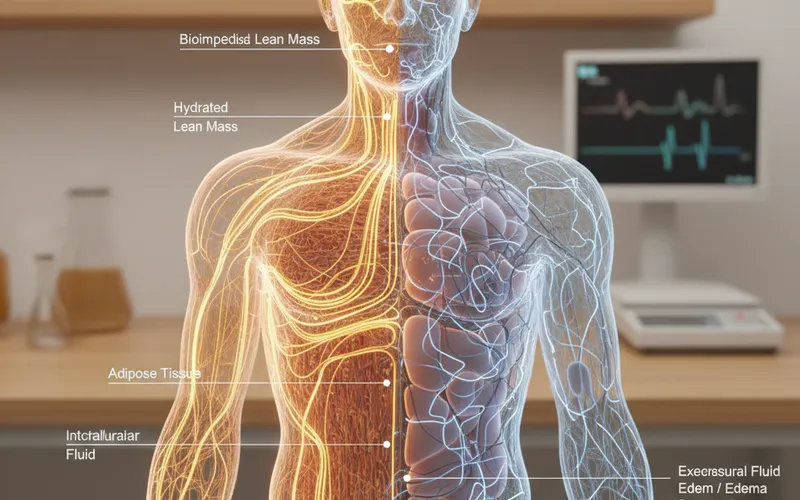
Bioelectrical impedance analysis is based on the principle that electrical currents are conducted differently through various body tissues. Water-rich tissues like muscles and organs conduct electricity well because they contain many electrolytes that act as charge carriers. Adipose tissue, on the other hand, is low in water and offers higher resistance to the current. BIA devices send a weak, harmless alternating current through the body and measure resistance (impedance) and reactance (phase angle). From these measurements, and considering age, gender, height, and weight, algorithms calculate body composition. It is important to understand that BIA is not a direct measurement of body composition, but an estimation based on complex mathematical models. The quality of this estimation heavily depends on the quality of the device, the algorithms used, and, most importantly, the standardization of measurement conditions.
The Limitations of BIA from a Psychophysiological Perspective
Classic validation studies show that BIA, under standardized conditions – fasted, rested, and without intense exertion in the last 24 hours – can have an error rate of ±2-3% for body fat. This precision is impressive, but the reality of modern life is rarely standardized. This is precisely where Jürg Hösli's psychophysiological approach comes in: the pure number is only part of the story. The individual's psychological and physical states influence the measurement and must be included in the interpretation to draw meaningful conclusions.
Dehydration and the Autonomic Nervous System: A Deeper Look
Slight dehydration, often unnoticed in daily life, can significantly distort measurement results, especially the estimation of body water and thus indirectly fat-free mass. However, dehydration is not just a matter of fluid intake; it can also be an indicator of a stressed state. An overactive sympathetic nervous system, our 'fight-or-flight' system, can lead to increased water and electrolyte excretion, which affects BIA measurements. Chronic stress can disrupt the body's homeostasis and lead to subtle shifts in fluid balance, which are reflected in BIA values. BIA thus becomes an indirect indicator of vegetative balance and can point to a dysregulation of the autonomic nervous system long before other symptoms manifest. This underscores the need to consider the psychological state and stress level when interpreting BIA results.
Exercise and Stress: Effects on Measurement Results
Intense physical activity significantly alters fluid distribution in the body and electrolyte balance. During exercise, fluid shifts from the intracellular space to the extracellular space, and there is increased fluid loss through sweating. This affects the electrical conductivity of tissues and leads to distorted BIA results. A measurement immediately after exercise is therefore inaccurate and can lead to an underestimation of body fat and an overestimation of muscle mass. From a psychophysiological perspective, this is a clear example of the need to consider the influence of stress on the body. BIA measurements should always be viewed in the context of the individual's stress and recovery strategy to detect overload early. A significant decrease in phase angle after intense exertion, for example, could indicate insufficient recovery and an increased cellular stress response, which goes far beyond mere body composition.
Extreme Body Compositions and Metabolic Bottlenecks: When BIA Reaches Its Limits
In severely obese or extremely muscular individuals, as well as in people with metabolic diseases, BIA can reach its limits. Standardized algorithms are often calibrated for an average population and can yield inaccurate results for extreme body types. Jürg Hösli sees the need to dig deeper here: Are micronutrient deficiencies or mitochondrial dysfunctions the cause of stagnant body composition or unexplained weight gain? BIA can provide initial clues that then need to be substantiated by further diagnostics (e.g., hormone status, micronutrient analyses). An unexpectedly low phase angle in a seemingly healthy person, for example, could indicate subclinical inflammation or an energy deficit at the cellular level that impairs cell membrane integrity. Here, BIA becomes a screening instrument that paves the way for more comprehensive functional diagnostics.
The Phase Angle: A Key Indicator for Cell Health and Stress
The phase angle, an often-overlooked parameter of BIA, is of particular importance from a psychophysiological perspective. It reflects the integrity of cell membranes and the amount of intracellular water relative to extracellular water. A higher phase angle indicates healthy, intact cells and good hydration, while a low phase angle can indicate cell damage, inflammation, or chronic stress. Jürg Hösli interprets the phase angle as a marker for cell vitality and resilience. A continuously decreasing phase angle can be an early warning sign of overtraining, chronic stress, or incipient metabolic problems, even if the pure fat and muscle mass values are still within the normal range. This allows for preventive action and adjustment of diet, training, or stress management strategies before serious health problems arise.
Practical Recommendations for BIA Application
To optimally use BIA in a psychophysiological context, the following recommendations are crucial:
- Standardization of measurement conditions: Always perform measurements at the same time of day, under similar conditions (e.g., in the morning after waking up, before breakfast, after using the toilet). Avoid measurements after intense exercise, alcohol consumption, or strong coffee.
- Regularity instead of single measurement: A single BIA measurement is just a snapshot. Only trend analysis over several weeks and months provides meaningful information about changes in body composition and psychophysiological state.
- Holistic interpretation: Never view BIA values in isolation. Always include the client's current lifestyle, stress level, sleep quality, eating habits, and subjective well-being in the interpretation.
- Focus on the phase angle: Pay special attention to the phase angle
Book Tip
By Jürg Hösli – matching the topic