Gestresst und Zahnfleischentzündung? Wie Psyche und Mundflora zusammenhängen
Chronischer Stress kann Parodontitis verschlimmern, indem er die Mundflora verändert und Entzündungen fördert. Eine neue Studie zeigt, wie Omega-3-Fettsäuren hier helfen könnten und betont die untrennbare Verbindung zwischen Geist und Körper.
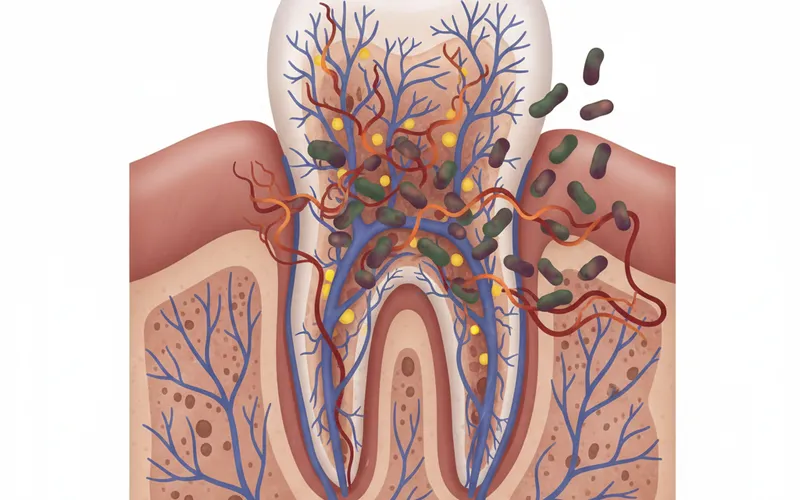
Die Studie – Was wurde untersucht und warum betrifft dich das?
Hast du dich jemals gefragt, ob der Stress im Alltag nicht nur deine Nerven, sondern auch dein Zahnfleisch angreift? Vielleicht hast du bemerkt, dass dein Zahnfleisch in stressigen Zeiten empfindlicher wird oder stärker blutet. Diese Beobachtung ist alles andere als Zufall, denn eine brandneue Studie aus China und Neuseeland beleuchtet genau diesen Zusammenhang: den engen, bisher wenig verstandenen Tanz zwischen chronischem Stress, unserer Mundflora und der gefürchteten Parodontitis.
Ein Team von Forschenden der Chongqing Medical University und der University of Otago hat sich dieser komplexen Interaktion angenommen. Sie wollten verstehen, wie chronischer psychologischer Stress die Entstehung und den Verlauf von Parodontitis beeinflusst und welche Rolle dabei die winzigen Bewohner unseres Mundes – das Mundmikrobiom – spielen. Die zentrale Fragestellung war, wie Stress über das Mikrobiom Entzündungsreaktionen im Körper verstärken kann, insbesondere im Bereich des Zahnfleisches.
Für ihre Untersuchung kombinierten die Wissenschaftler klinische Beobachtungen an Menschen mit detaillierten Tiermodellen. Sie stellten fest, dass depressive Symptome bei Menschen signifikant mit der Schwere der Parodontitis korrelieren und dass dies mit einer veränderten Zusammensetzung der Mundflora einhergeht. Im Tiermodell (Mäuse, die chronischem Stress ausgesetzt waren) zeigte sich, dass dieser Stress die Mundflora so veränderte, dass die Parodontitis verstärkt wurde. Besonders beeindruckend: Als die Forschenden die Darmflora von gestressten Mäusen auf keimfreie Mäuse übertrugen, entwickelten diese ebenfalls eine stärkere Parodontitis. Das deutet auf einen kausalen Zusammenhang hin und zeigt, dass die durch Stress veränderte Mikrobiota tatsächlich die Krankheit übertragen kann.
Die metabolische Analyse – also die Untersuchung der Stoffwechselprodukte – ergab, dass gestresste Mäuse mit Parodontitis weniger Eicosapentaensäure (EPA) aufwiesen. EPA ist eine Omega-3-Fettsäure, die für ihre entzündungshemmenden Eigenschaften bekannt ist. Und hier kommt der therapeutische Ansatz ins Spiel: Die Supplementierung mit EPA konnte die Parodontitis lindern, indem sie einen pro-entzündlichen Signalweg (NF-κB) unterdrückte und so die Aktivierung von entzündungsfördernden Immunzellen (M1-Makrophagen) hemmte. Diese Ergebnisse deuten auf eine neue «Darm-Mund-Achse» hin, die durch Stress, Mikrobiota und Stoffwechselprodukte vermittelt wird, und positionieren EPA als vielversprechenden Wirkstoff gegen stressbedingte Entzündungskrankheiten.
Quelle: Luo S, Lou F, Yang P, Zhang Y, Yan L, Dong Y, Yang B, Wang H, Liu Y, Pu J, Cannon RD, Xie P, Ji P, Jin X (2026). Dysregulation of Oral Microbial Eicosapentaenoic Acid Induced by Chronic Restraint Stress Exacerbates Periodontitis via M1 Macrophage Polarization. Advanced science (Weinheim, Baden-Wurttemberg, Germany). PubMed-ID: 41783924
Was heisst das wirklich? – Die kritische Einordnung
Diese Studie liefert faszinierende Einblicke in ein komplexes Zusammenspiel. Doch was bedeuten diese Ergebnisse wirklich für dich? Zunächst einmal ist es wichtig zu verstehen, dass wir hier von einem Tiermodell sprechen, das durch klinische Beobachtungen am Menschen ergänzt wurde. Die Übertragbarkeit von Mäusestudien auf den Menschen ist oft ein Thema. Auch wenn die Korrelationen bei Menschen vielversprechend sind, sind die detaillierten Mechanismen vor allem im Tiermodell untersucht worden.
Die Forschenden haben hier einen «harten Endpunkt» gemessen: die Schwere der Parodontitis. Das ist gut, denn es geht nicht nur um Surrogatparameter. Die Identifikation von EPA als potenziellem therapeutischen Ansatzpunkt ist ebenfalls ein starkes Ergebnis. Die Idee, dass die Veränderung der Mikrobiota kausal zur Verschlimmerung der Erkrankung beiträgt, ist durch den fäkalen Mikrobiota-Transfer sehr elegant gezeigt worden.
Was sind die Grenzen? Die Studie spricht von chronischem «restraint stress» bei Mäusen, einer Form von physischem und psychischem Stress, der nicht eins zu eins mit dem komplexen psychosozialen Stress des Menschen vergleichbar ist. Auch wenn die depressive Symptomatik bei Menschen korrelierte, wurde der kausale Zusammenhang zwischen Stress, Mikrobiom und Parodontitis vor allem im Tiermodell belegt. Die Teilnehmergruppe der menschlichen Beobachtungsstudie wird im Abstract nicht detailliert beschrieben, was die Verallgemeinerbarkeit einschränkt.
Denkwerkzeug: Stell dir vor, du bist gestresst und dein Zahnfleisch ist entzündet. Ist es für dich denkbar, dass dein Stress nicht nur dein Nervensystem, sondern auch die kleinen Bewohner in deinem Mund beeinflusst und dadurch die Entzündung verstärkt? Wenn ja, ist diese Studie für dich relevant.
Der Geist im Körper – Die psychophysiologische Perspektive
Hier kommen wir zum Kern dessen, was Jürg Höslis Plattform ausmacht: die untrennbare Verbindung von Psyche und Körper. Diese Studie ist ein Paradebeispiel dafür, wie psychologischer Stress – in diesem Fall chronischer Stress – direkt in physiologische Prozesse eingreift und Krankheiten beeinflusst. Es ist nicht nur «Einbildung», wenn du spürst, dass dein Körper unter Stress leidet. Dein Zahnfleisch ist keine Ausnahme.
Das psychophysiologische Interaktionsmodell besagt, dass Stress nicht nur über Hormone wie Cortisol wirkt, sondern eine Kaskade von Reaktionen auslöst, die bis auf die Ebene unseres Mikrobioms reichen können. Die Studie zeigt: Dein Stresslevel kann die Zusammensetzung deiner Mund- und Darmflora verändern. Diese veränderte Mikrobiota wiederum produziert andere Stoffwechselprodukte – wie das hier identifizierte EPA – oder eben nicht. Und diese Metaboliten beeinflussen dann direkt deine Immunantwort und Entzündungsprozesse. Es ist ein komplexes Zusammenspiel, bei dem deine Psyche die Startlinie bildet für eine Kette von körperlichen Reaktionen.
Gerade bei entzündlichen Erkrankungen wie Parodontitis ist der Einfluss von Stress oft massiv unterschätzt. Viele Betroffene konzentrieren sich auf die lokale Behandlung, übersehen aber, dass die Wurzel des Problems tiefer liegen könnte – im chronischen Stress, der das gesamte System in einen pro-entzündlichen Zustand versetzt. Dein Körper reagiert nicht nur auf die Bakterien im Mund, sondern auch auf die Signale, die dein Gehirn aufgrund deines Stresslevels aussendet. Es ist gut denkbar, dass eine Person, die sich gestresst fühlt, anfälliger für die Entzündung ist, selbst wenn die Mundhygiene konstant bleibt. Die Erwartungshaltung, dass Stress krank macht, kann sogar den Nocebo-Effekt verstärken und die Symptome verschlimmern.
Der grössere Kontext – Einordnung und Abhängigkeiten
Diese Studie fügt sich gut in die wachsende Erkenntnis ein, dass der Darm und seine Mikrobiota eine zentrale Rolle für die gesamte Körpergesundheit spielen – und dass diese Achse weit über den Darm hinausreicht, bis in den Mund und darüber hinaus. Die Idee der «Darm-Mund-Achse» unter Stress ist neu und spannend. Sie bestätigt frühere Forschungen, die bereits einen Zusammenhang zwischen Stress und verschiedenen entzündlichen Erkrankungen aufgezeigt haben, erweitert aber das Verständnis um die entscheidende Rolle des Mikrobioms und spezifischer Metaboliten.
Hinsichtlich der Finanzierung und möglicher Interessenkonflikte ist festzuhalten, dass die Studie von verschiedenen staatlichen Förderprogrammen in China unterstützt wurde, was auf eine unabhängige Forschungsinitiative hindeutet. Es gibt keine Hinweise auf direkte kommerzielle Interessenkonflikte, was die Glaubwürdigkeit der Ergebnisse stärkt.
Was wurde nicht kontrolliert? Wie bei vielen Studien, die sich auf spezifische Mechanismen konzentrieren, wurden andere wichtige Lebensstilfaktoren, die Parodontitis beeinflussen können (Ernährung ausserhalb der EPA-Supplementierung, Rauchen, Alkoholkonsum, Schlafqualität, andere Stressbewältigungsstrategien), nicht explizit als Teil des Studiendesigns berücksichtigt. Das ist keine Schwäche der Studie an sich, sondern eine notwendige Abgrenzung. Für dich bedeutet es jedoch, dass die Wirkung von Stress auf deine Parodontitis immer im Kontext deines gesamten Lebensstils zu sehen ist.
Denkwerkzeug: Wenn du diese Studie liest, überlege: Gibt es in deinem Leben andere Faktoren – Ernährung, Schlaf, Bewegung – die ebenfalls deine Stressreaktion oder deine Entzündungsbereitschaft beeinflussen könnten? Würdest du dein Verhalten basierend auf einer einzigen Studie ändern, oder würdest du abwarten, bis weitere Forschungen diese Ergebnisse bestätigen und erweitern?
Was heisst das für dich? – Fazit und Alltagsrelevanz
Was kannst du aus dieser spannenden Forschung für dein eigenes Leben mitnehmen? Hier sind 2–3 konkrete Erkenntnisse:
- Stressmanagement ist Zahnpflege: Diese Studie untermauert eindrücklich, dass dein Stresslevel nicht nur deine mentale, sondern auch deine körperliche Gesundheit beeinflusst – bis hin zu deinem Zahnfleisch. Effektives Stressmanagement ist daher ein wichtiger, oft übersehener Pfeiler deiner Mundgesundheit. Ob Achtsamkeit, Bewegung oder ausreichend Schlaf: Finde deine persönlichen Strategien, um chronischen Stress zu reduzieren.
- Omega-3-Fettsäuren könnten eine Rolle spielen: Die positiven Effekte von EPA im Tiermodell sind vielversprechend. Es könnte sich lohnen, deine Ernährung um Omega-3-reiche Lebensmittel wie fettreichen Fisch (Lachs, Makrele, Hering) zu ergänzen oder über eine Supplementierung nachzudenken. Dies sollte aber immer in Absprache mit einem Arzt oder Apotheker geschehen.
- Dein Mikrobiom ist ein Schlüssel: Die Studie zeigt, wie wichtig ein gesundes Mikrobiom ist. Eine ausgewogene und vielfältige Ernährung mit vielen Ballaststoffen kann dazu beitragen, deine Darm- und damit indirekt auch deine Mundflora positiv zu beeinflussen.
Was solltest du NICHT daraus schliessen? Diese Studie ist ein wichtiger Puzzlestein, aber keine Patentlösung. Sie ersetzt keinesfalls eine gute Mundhygiene mit regelmässigem Zähneputzen und Zahnarztbesuchen. Auch wenn EPA vielversprechend ist, ist es wichtig, weitere Humanstudien abzuwarten, bevor man es als definitives Heilmittel betrachtet. Verlass dich nicht allein auf ein Supplement, sondern betrachte deine Gesundheit ganzheitlich.
Diese Erkenntnisse sind besonders relevant für Menschen, die unter chronischem Stress leiden und gleichzeitig mit wiederkehrenden Zahnfleischentzündungen kämpfen. Für Menschen ohne diese Probleme ist es eine gute Erinnerung an die Bedeutung eines ausgewogenen Lebensstils.
Dein Körper reagiert nicht nur auf das, was du isst oder wie du dich bewegst – sondern auch auf das, was du denkst und fühlst. Die Forschung zur Wechselwirkung von Psyche, Mikrobiom und Gesundheit steht noch am Anfang, aber sie zeigt uns immer wieder, wie eng alles miteinander verbunden ist. Es bleibt spannend zu sehen, welche weiteren Geheimnisse der Geist im Körper noch für uns bereithält. Bleib neugierig und hör auf deinen Körper!
Wissenschaftliche Quelle
Advanced science (Weinheim, Baden-Wurttemberg, Germany)