Broccolini länger frisch: Wie Stickstoffmonoxid das Vergilben verzögert
Eine aktuelle Studie aus China zeigt, wie Stickstoffmonoxid (NO) Broccolini nach der Ernte länger frisch hält. Die Forschung beleuchtet die komplexen Mechanismen, die das Vergilben verhindern und könnte neue Wege für die Haltbarkeit von Gemüse eröffnen. Doch was bedeutet das für dich und deine Ernährung?
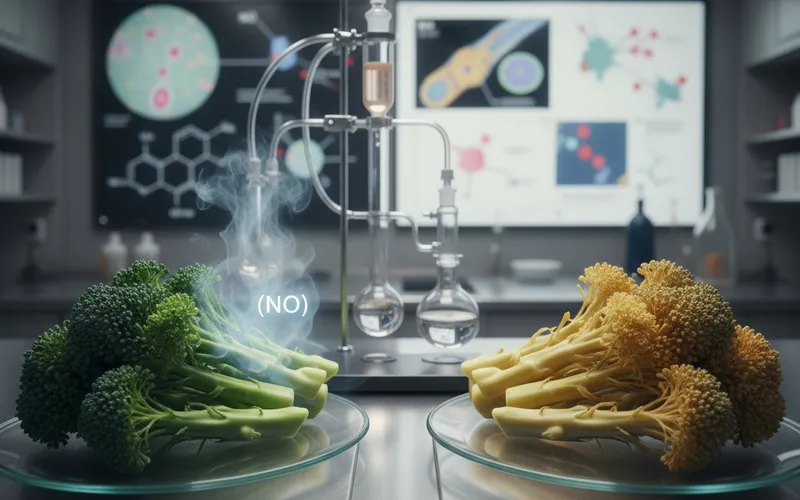
1. Die Studie – Was wurde untersucht und warum betrifft dich das?
Kennst du das? Du kaufst frischen Broccolini im Laden, freust dich auf knackiges Gemüse, und schon nach wenigen Tagen beginnt er unweigerlich zu vergilben. Die einst leuchtend grüne Farbe weicht einem fahlen Gelb, die Textur wird weicher, und der Appetit schwindet. Dieses schnelle Verderben ist nicht nur ärgerlich für uns Konsumenten, sondern stellt auch eine grosse Herausforderung für die Lebensmittelindustrie dar und trägt massgeblich zur Lebensmittelverschwendung bei. Genau hier setzt eine spannende Studie aus China an, die einen vielversprechenden Ansatz zur Verlängerung der Haltbarkeit von Broccolini untersucht hat.
Ein Forschungsteam um Gao W, Li C, Niu G, Ge Y und Luo F von der Jinzhou Medical University und der Tianjin Academy of Agricultural Sciences hat sich der Frage gewidmet, wie Stickstoffmonoxid (NO) das Vergilben von Broccolini nach der Ernte beeinflusst. Die Studie, publiziert im Journal Frontiers in Nutrition, konzentrierte sich darauf, die zugrunde liegenden Mechanismen zu entschlüsseln, durch die NO diesen Alterungsprozess verzögern kann.
Die Forschenden nutzten ein experimentelles Design, um die Wirkung von Stickstoffmonoxid zu untersuchen. Sie behandelten Broccolini-Proben entweder mit einem NO-Fänger (cPTIO), um die natürliche NO-Wirkung zu unterbinden, oder mit einem exogenen NO-Donator (GSNO), um die NO-Konzentration zu erhöhen. Eine Kontrollgruppe erhielt keine Behandlung. Anschliessend wurde die Qualität des Broccolini über die Lagerzeit hinweg bewertet, insbesondere hinsichtlich Farbe, Chlorophyllgehalt und der Integrität der Chloroplastenmembranen. Die Stichprobe bestand aus frisch geerntetem Broccolini, der unter kontrollierten Bedingungen gelagert wurde.
Die zentralen Ergebnisse waren beeindruckend: Die Behandlung mit dem NO-Donator (GSNO) verzögerte das Vergilben des Broccolini um ganze vier Tage im Vergleich zur Kontrollgruppe. Bei den behandelten Proben blieben die Chloroplastenmembranen während des gesamten Lagerprozesses gut entwickelt, während sie in der cPTIO-Gruppe bereits nach vier Tagen zu kollabieren begannen. GSNO verbesserte die Permeabilität der Zellmembran, erhöhte die Spiegel wichtiger Chloroplastenmembranlipide (Monoglycosyldiacylglycerol, Phosphatidylglycerol und Digalactosyldiacylglycerol) und steigerte die Aktivität des ω-3 FAD-Enzyms. Zudem förderte es den Ascorbat-Glutathion-Zyklus und die Transkription von BoFAD8, was zur Anreicherung von 18/16:3-Trien-Fettsäuren führte. Auch das Gen BoPPT1, das an der Regulierung der Chloroplastenmorphologie beteiligt ist, wurde durch GSNO hochreguliert. All diese Effekte deuten darauf hin, dass Stickstoffmonoxid oxidative Schäden am Chloroplasten-Membranlipidsystem mindert und so das Vergilben des Broccolini verzögert.
Quelle: Gao W, Li C, Niu G, Ge Y, Luo F (2026). Nitric oxide delays yellowing by regulating chloroplast membrane lipid metabolism and the ascorbate-glutathione cycle in postharvest broccolini. Front Nutr, 13:1785583. PubMed-ID: 41809102
Diese Erkenntnisse sind faszinierend, denn sie zeigen uns nicht nur, wie wir unser Gemüse länger frisch halten könnten, sondern geben auch tiefe Einblicke in die komplexen biochemischen Prozesse, die hinter dem Verderb stecken. Doch was bedeuten diese Laborergebnisse wirklich für unsere Küche und unseren Einkaufskorb?
2. Was heisst das wirklich? – Die kritische Einordnung
Die Ergebnisse dieser Studie sind auf den ersten Blick sehr vielversprechend. Eine Verlängerung der Haltbarkeit um vier Tage ist ein signifikanter Fortschritt, sowohl für den Handel als auch für uns Konsumenten. Aber wie immer, wenn wir von wissenschaftlichen Studien sprechen, müssen wir genauer hinschauen und die Ergebnisse kritisch einordnen.
Du bist kein Durchschnitt. Die Studie zeigt statistisch signifikante Effekte. Das bedeutet, die beobachteten Unterschiede zwischen den behandelten und unbehandelten Proben sind mit hoher Wahrscheinlichkeit nicht zufällig. Doch hier geht es um Broccolini, nicht um den menschlichen Körper. Die „klinische Signifikanz“ ist hier eher eine „praktische Signifikanz“ für die Lebensmitteltechnologie. Für den Broccolini ist ein längeres Leben natürlich bedeutsam.
Was wurde wirklich gemessen? Die Forschenden haben harte Endpunkte für die Qualität von Broccolini gemessen: Vergilbung (Farbe), Chlorophyllgehalt und die Struktur der Chloroplastenmembranen. Diese Parameter sind direkt mit der Frische und dem Verderb des Gemüses verbunden. Es handelt sich also nicht um Surrogatparameter im Sinne von Laborwerten, die indirekt auf einen Gesundheitszustand schliessen lassen. Hier ist das Messobjekt direkt das, worum es geht: die Haltbarkeit des Gemüses.
Methodische Stärken und Grenzen: Die Studie ist im Design klar: Sie verwendet sowohl einen NO-Donator als auch einen NO-Fänger, was eine gute Kontrolle ermöglicht und die kausale Rolle von NO untermauert. Die detaillierte Analyse der biochemischen Wege (Membranlipidstoffwechsel, Ascorbat-Glutathion-Zyklus) liefert fundierte Erklärungen für die beobachteten Effekte. Eine Grenze ist natürlich, dass es sich um eine Laborstudie unter kontrollierten Bedingungen handelt. Die Übertragbarkeit auf die komplexen Bedingungen in der Lieferkette oder im heimischen Kühlschrank ist nicht eins zu eins gegeben. Faktoren wie Temperaturschwankungen, mechanische Belastung oder die Anwesenheit anderer Mikroorganismen wurden hier nicht umfassend untersucht.
Für wen gelten die Ergebnisse? Die Ergebnisse gelten für Broccolini. Ob ähnliche Effekte auch bei anderen Gemüsesorten auftreten, müsste in weiteren Studien untersucht werden. Stickstoffmonoxid spielt zwar eine wichtige Rolle in vielen biologischen Systemen, aber die spezifischen Mechanismen können variieren.
Als Denkwerkzeug für dich: Wenn du das nächste Mal im Supermarkt bist und ein Produkt siehst, das mit einer verlängerten Haltbarkeit wirbt, frage dich: Wie wurde diese Haltbarkeit erreicht und welche potenziellen Auswirkungen könnte das auf andere Eigenschaften des Produkts haben?
Diese Studie ist ein wichtiger Schritt für die Lebensmitteltechnologie, aber sie bleibt im Bereich der Pflanzenphysiologie. Das bringt uns zu einer Perspektive, die in vielen Studien oft fehlt, aber für uns Menschen von entscheidender Bedeutung ist.
3. Der Geist im Körper – Die psychophysiologische Perspektive
Auch wenn diese Studie sich auf Broccolini konzentriert, können wir aus einer psychophysiologischen Perspektive interessante Analogien ziehen. Beim Menschen spielt Stickstoffmonoxid (NO) eine entscheidende Rolle in vielen physiologischen Prozessen, wie der Gefässerweiterung, der Immunantwort und der neuronalen Signalübertragung. Die Produktion von NO im Körper wird stark von unserem Lebensstil, unserer Ernährung und – ganz wichtig – von unserem psychischen Zustand beeinflusst.
Stell dir vor, du konsumierst Lebensmittel, die du als besonders «frisch» oder «gesund» wahrnimmst. Allein diese positive Erwartungshaltung, der sogenannte **Placebo-Effekt**, kann messbare physiologische Veränderungen in deinem Körper auslösen. Wenn du also weisst, dass dein Broccolini durch eine spezielle Behandlung länger frisch bleibt, isst du ihn vielleicht mit einem besseren Gefühl, was sich wiederum positiv auf deine Verdauung und Nährstoffaufnahme auswirken könnte – auch wenn der direkte physiologische Mechanismus hier ein anderer ist.
Umgekehrt kann chronischer Stress oder eine negative Erwartungshaltung die körpereigene NO-Produktion und -Verwertung beeinträchtigen. Wenn du gestresst bist, kann das physiologische Gleichgewicht deines Körpers – inklusive deiner Fähigkeit, Nährstoffe optimal zu verarbeiten und freie Radikale zu bekämpfen – gestört sein. Dies ist zwar weit entfernt vom Vergilben eines Broccolini, aber es zeigt, wie stark die Psyche die physiologischen Abläufe im menschlichen Körper beeinflusst.
In dieser Broccolini-Studie sehen wir, wie NO oxidative Schäden an den Chloroplastenmembranen mindert. Beim Menschen ist oxidativer Stress ein zentraler Faktor bei vielen Krankheiten und Alterungsprozessen. Es ist gut denkbar, dass auch hier die psychische Verfassung, etwa durch die Modulation von Stresshormonen, die körpereigenen Antioxidantien und die NO-Verfügbarkeit beeinflusst, was wiederum Auswirkungen auf die zelluläre Integrität und die Widerstandsfähigkeit gegenüber oxidativem Stress hat. Eine Studie, die die psychische Verfassung von Personen erfasst, die „frische“ oder „weniger frische“ Lebensmittel konsumieren, könnte interessante Zusammenhänge aufzeigen – auch wenn der Broccolini selbst nicht von seinen Emotionen beeinflusst wird, so doch der Mensch, der ihn isst.
Der **Hawthorne-Effekt** ist hier nicht direkt anwendbar, da Broccolini kein Bewusstsein hat. Aber im Kontext der Lebensmittelproduktionskette könnte das Wissen um eine Behandlung mit NO die Sorgfalt der Mitarbeitenden erhöhen, da sie wissen, dass die Qualität des Gemüses verbessert wird. Das würde dann die Wirkung der NO-Behandlung indirekt verstärken.
4. Der grössere Kontext – Einordnung und Abhängigkeiten
Diese Studie ist ein wichtiges Puzzleteil im Kampf gegen die Lebensmittelverschwendung und zur Verbesserung der Lebensmittelsicherheit. Die Autoren haben klar angegeben, dass die Arbeit in Abwesenheit jeglicher kommerzieller oder finanzieller Beziehungen durchgeführt wurde, die als potenzieller Interessenkonflikt ausgelegt werden könnten. Das stärkt die Glaubwürdigkeit der Ergebnisse.
Die Forschung zum Einsatz von Stickstoffmonoxid zur Verlängerung der Haltbarkeit von Obst und Gemüse ist nicht neu, aber diese Studie liefert detaillierte Einblicke in die spezifischen biochemischen Mechanismen beim Broccolini. Sie bestätigt prinzipiell bestehende Erkenntnisse über die Rolle von NO als Signalmolekül in Pflanzen, erweitert diese jedoch um spezifische Details zum Chlorophyllabbau und Membranlipidstoffwechsel. Es ist kein Ausreisser, sondern eine fundierte Vertiefung des bestehenden Wissens.
Was wurde nicht kontrolliert? Die Studie konzentrierte sich auf die Wirkung von NO unter Laborbedingungen. Im realen Leben gibt es jedoch eine Vielzahl von Faktoren, die die Haltbarkeit von Broccolini beeinflussen: die genaue Sorte, die Anbaumethoden, der Erntezeitpunkt, die Transportbedingungen, die Lagerung im Supermarkt (Licht, Temperatur, Feuchtigkeit) und schliesslich die Lagerung im Haushalt. Auch die Verpackung spielt eine grosse Rolle. All diese Aspekte wurden in dieser spezifischen Studie nicht umfassend kontrolliert, was aber keine Schwäche der Studie an sich ist, sondern eine notwendige Begrenzung, um die spezifische Fragestellung präzise beantworten zu können.
Als Denkwerkzeug für dich: Bevor du aufgrund einer einzelnen wissenschaftlichen Erkenntnis deine gesamte Einkaufsstrategie änderst, frage dich: Welche anderen Faktoren könnten die beworbene Wirkung beeinflussen, und werden diese in der Studie berücksichtigt?
Diese Forschung könnte die Basis für neue Technologien zur post-harvest Behandlung legen, die letztlich dazu beitragen, dass frisches Gemüse länger verfügbar ist und weniger weggeworfen wird. Aber was heisst das konkret für dich in deinem Alltag?
5. Was heisst das für dich? – Fazit und Alltagsrelevanz
Diese Studie über Broccolini und Stickstoffmonoxid mag auf den ersten Blick sehr spezifisch erscheinen, doch sie birgt relevante Botschaften für deinen Alltag als gesundheitsbewusster Mensch:
- Achte auf Frische: Auch wenn NO-Behandlungen in der breiten Anwendung noch nicht Standard sind, erinnert uns die Studie daran, wie wichtig die Frische von Gemüse ist. Wähle beim Einkauf Gemüse, das knackig ist, eine kräftige Farbe hat und keine Anzeichen von Vergilbung zeigt. Die visuelle Qualität ist oft ein guter Indikator für den Nährwert.
- Optimale Lagerung zu Hause: Solange du keine «NO-Behandlung» für deinen Broccolini zu Hause hast, ist die richtige Lagerung entscheidend. Lagere ihn im Kühlschrank, idealerweise in einem leicht geöffneten Beutel, um die Feuchtigkeit zu bewahren und gleichzeitig eine gewisse Belüftung zu ermöglichen.
- Lebensmittelverschwendung reduzieren: Diese Forschung ist ein Beispiel dafür, wie Wissenschaft dazu beitragen kann, Lebensmittelverschwendung zu reduzieren. Indem du deinen Broccolini rechtzeitig verbrauchst oder einfrierst, trägst du aktiv dazu bei.
Was solltest du NICHT daraus schliessen? Diese Studie ist kein Freifahrtschein, um weniger auf die Qualität deines Gemüses zu achten. Auch wenn zukünftig Methoden zur Haltbarkeitsverlängerung eingesetzt werden, bleibt das Prinzip, frische, saisonale und lokal angebaute Produkte zu bevorzugen, bestehen. Es geht nicht darum, nun Broccolini zu kaufen, der vielleicht schon Tage länger liegt, nur weil er behandelt wurde. Vielmehr geht es um die Optimierung der gesamten Lieferkette.
Für dich persönlich ist es besonders relevant, wenn du Wert auf maximale Frische und Nährstoffdichte legst. Die Studie zeigt, wie empfindlich die Zellstrukturen von Pflanzen sind und wie schnell sie nach der Ernte abbauen können. Das unterstreicht die Wichtigkeit, Gemüse möglichst zeitnah nach dem Einkauf zu verzehren.
Der psychophysiologische Gedanke zum Schluss: Denk daran, dass deine Gesundheit immer ein Zusammenspiel von Körper und Geist ist. Während dein Broccolini keine Gefühle hat, beeinflusst deine Wertschätzung für frische, unverarbeitete Lebensmittel und deine Überzeugung, dich gesund zu ernähren, deinen eigenen Körper und seine Fähigkeit, Nährstoffe zu verwerten. Dein Körper reagiert nicht nur auf das, was du isst, sondern auch auf die Einstellung, mit der du es tust. Ein achtsamer und positiver Zugang zu deiner Ernährung kann die physiologischen Effekte verstärken.
Welche weiteren Mechanismen bei anderen Gemüsesorten das Verderben beeinflussen und wie wir diese Erkenntnisse intelligent für eine nachhaltigere Lebensmittelversorgung nutzen können, bleibt eine spannende Frage für die zukünftige Forschung. Bleib neugierig und wertschätze die Frische auf deinem Teller!