Makrophagen im Stoffwechsel-Check: Wie Immunzellen ihre Energie gewinnen
Neue Methode entschlüsselt den Energiehaushalt von Makrophagen und zeigt, wie Immunzellen je nach Aufgabe ihren Stoffwechsel anpassen. Ein tiefer Einblick in die Schaltzentrale unserer Abwehr.
Die Studie – Was wurde untersucht und warum betrifft dich das?
Stell dir vor, dein Immunsystem ist wie eine Armee, die dich täglich vor Eindringlingen schützt. In dieser Armee gibt es Spezialisten, die Makrophagen. Sie sind die «grossen Fresser», die Krankheitserreger und Zelltrümmer beseitigen. Aber Makrophagen sind nicht gleich Makrophagen. Je nachdem, welche Aufgabe sie gerade erfüllen müssen, passen sie sich an. Das ist wie bei einem Soldaten, der mal im Nahkampf, mal in der Logistik eingesetzt wird – er braucht unterschiedliche Fähigkeiten und auch eine unterschiedliche Versorgung, um optimal zu funktionieren.
Genau das hat ein italienisches Forschungsteam um Cinquegrani, Spigoni und Fantuzzi von der Universität Parma untersucht. Sie wollten verstehen, wie Makrophagen ihren Stoffwechsel umstellen, wenn sie verschiedene Aufgaben übernehmen. Bisher gab es zwar Hinweise aus der Genforschung, dass Makrophagen je nach Funktion unterschiedliche Stoffwechselprogramme nutzen. Doch wie diese Programme tatsächlich ablaufen, also welche Nährstoffe in welcher Menge verbrannt werden, war noch unklar.
Um diese Lücke zu schliessen, haben die Forschenden zwei Dinge getan: Erstens entwickelten und validierten sie eine neuartige Methode zur indirekten Kalorimetrie auf Zellebene. Das ist wie eine kleine Stoffwechselwaage für einzelne Zellen, die genau misst, welche Nährstoffe die Zelle verbraucht und welche Abfallprodukte sie produziert. Zweitens nutzten sie diese Methode, um den Stoffwechsel von menschlichen Makrophagen zu charakterisieren, die in verschiedene Typen polarisiert wurden. Konkret schauten sie sich Makrophagen von gesunden Spendern an, die sie in drei Gruppen einteilten:
- M0-Makrophagen: Das sind die «neutralen» Makrophagen, bevor sie eine spezifische Aufgabe bekommen.
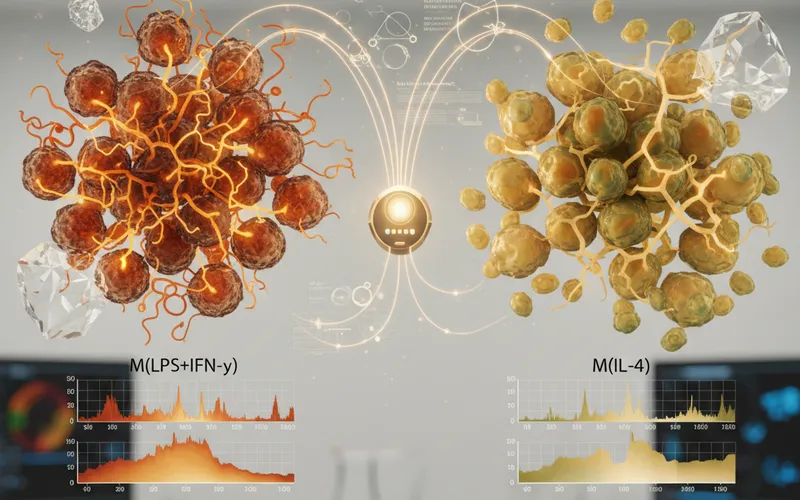
- M(LPS+IFN-γ)-Makrophagen: Diese sind entzündungsfördernd und werden aktiv, wenn es darum geht, Infektionen zu bekämpfen. Sie sind vergleichbar mit den sogenannten M1-Makrophagen.
- M(IL-4)-Makrophagen: Diese sind eher entzündungshemmend und an der Wundheilung sowie der Gewebereparatur beteiligt. Sie entsprechen den M2-Makrophagen.
Die Forschenden untersuchten diese Makrophagen in vier verschiedenen Nährmedien: ohne Substrat, nur mit Glukose, nur mit Glycyl-Glutamin (einer Aminosäure) und mit einer Kombination aus Glukose und Glycyl-Glutamin. Durch die Messung von Sauerstoffverbrauch, Protonenproduktion, Laktat- und Ammoniakfreisetzung konnten sie mithilfe eines komplexen mathematischen Modells (SAAM II Software) genau berechnen, wie die Zellen ihre Energie gewinnen.
Die zentralen Ergebnisse zeigen, dass Makrophagen Glukose für die Glykolyse nutzen, was etwa 30% des Citrat-Synthase-Flusses ausmacht. Vorwiegend nutzen sie jedoch Lipide zur Netto-Citrat-Synthese, dem ersten Schritt des Zitronensäurezyklus. Nach der Polarisierung zeigten die entzündungsfördernden M(LPS+IFN-γ)-Makrophagen eine erhöhte anaerobe Glykolyse im Vergleich zu den M0- und M(IL-4)-Makrophagen, während ihr Zitronensäurezyklus-Fluss ähnlich dem der M0-Makrophagen war. Die entzündungshemmenden M(IL-4)-Makrophagen hingegen wiesen einen höheren Zitronensäurezyklus-Fluss und höhere Malat-Enzym-Flüsse auf, insbesondere bei Glukose und Glycyl-Glutamin, und zeigten eine Tendenz zu einer verstärkten Lipidoxidation.
Die Studie wurde im «American Journal of Physiology – Cell Physiology» veröffentlicht und liefert eine robuste Methode, um den Stoffwechsel von Immunzellen präzise zu quantifizieren. Sie zeigt, dass die unterschiedlichen Makrophagen-Subtypen tatsächlich sehr spezifische Stoffwechselprofile aufweisen, die zu ihren jeweiligen immunologischen Funktionen passen.
Quelle: Cinquegrani G, Spigoni V, Fantuzzi F, D'Antuono A, Bagnaresi F, Giordano E, Burato A, Dei Cas A, Bonadonna RC (2026). A novel cell indirect calorimetry method unveils the metabolic fluxomic signatures of human monocyte derived M(LPS+IFN-γ) and M(IL-4) macrophages. American journal of physiology. Cell physiology. PubMed-ID: 41770302
Was heisst das wirklich? – Die kritische Einordnung
Diese Studie ist ein Paradebeispiel für Grundlagenforschung, die unser Verständnis von Immunzellen vertieft. Die Entwicklung einer präzisen Methode zur zellulären indirekten Kalorimetrie ist ein grosser Schritt nach vorn. Sie ermöglicht es, den Stoffwechsel von Zellen detaillierter zu untersuchen, als es bisher möglich war.
Du bist kein Durchschnitt: Die Ergebnisse dieser Studie sind statistisch signifikant, was bedeutet, dass die beobachteten Unterschiede im Stoffwechsel der Makrophagen wahrscheinlich nicht zufällig sind. Für dich als Einzelperson heisst das aber nicht sofort, dass du jetzt deine Ernährung umstellen musst. Die Studie wurde an isolierten menschlichen Makrophagen im Labor durchgeführt, nicht an Menschen. Das ist wichtig zu verstehen. Was auf Zellebene passiert, lässt sich nicht eins zu eins auf den komplexen menschlichen Körper übertragen, der von unzähligen weiteren Faktoren beeinflusst wird.
Was wurde wirklich gemessen? Hier wurden harte physiologische Endpunkte auf Zellebene gemessen: Sauerstoffverbrauch, Protonenproduktion, Laktat- und Ammoniakfreisetzung. Das sind sehr genaue Indikatoren für den Energiefluss in den Zellen. Es sind keine Surrogatparameter im Sinne von «vielleicht könnte es so sein». Die Methodik ist hier eine grosse Stärke der Studie. Allerdings ist es eine Messung der Fluxomik, also der Flussraten des Stoffwechsels, nicht der direkten Auswirkungen auf die Gesundheit eines Menschen. Ein verbesserter Stoffwechsel in einer isolierten Zelle ist ein wertvoller Hinweis, aber kein direkter Beweis für eine verbesserte Immunfunktion im lebenden Organismus.
Methodische Stärken und Grenzen: Die grösste Stärke ist zweifellos die Entwicklung und Validierung der neuen Kalorimetrie-Methode. Sie liefert präzise Daten über den zellulären Stoffwechsel. Auch die Verwendung von primären menschlichen Zellen (Monocyten-abgeleiteten Makrophagen von gesunden Spendern) ist ein Pluspunkt, da dies relevanter ist als Zelllinien. Eine Grenze ist natürlich der In-vitro-Charakter: Die Zellen wurden unter sehr kontrollierten Bedingungen im Labor gehalten. Im Körper sind Makrophagen einem viel komplexeren Umfeld ausgesetzt, mit anderen Zellen, Hormonen, Zytokinen und Nährstoffschwankungen. Diese Komplexität kann im Labor nicht vollständig abgebildet werden.
Für wen gelten die Ergebnisse? Die Ergebnisse gelten primär für menschliche Makrophagen unter den spezifischen Laborbedingungen dieser Studie. Für dich als gesunden Menschen sind sie ein Puzzleteil, das hilft, die komplexen Mechanismen deines Immunsystems besser zu verstehen. Wenn du wissen willst, wie relevant diese Erkenntnisse für deine persönliche Gesundheit sind, könntest du dich fragen: Wie weit kann ich die Erkenntnisse aus einer Laborstudie über isolierte Zellen auf meinen komplexen Organismus übertragen, der von so vielen weiteren Faktoren beeinflusst wird?
Der Geist im Körper – Die psychophysiologische Perspektive
Jetzt kommen wir zu einem Aspekt, der in solchen Laborstudien oft völlig ausgeblendet wird, aber für dich im Alltag von entscheidender Bedeutung ist: die psychophysiologische Dimension. Die Studie zeigt sehr schön, wie Makrophagen ihren Stoffwechsel anpassen, wenn sie eine bestimmte Aufgabe übernehmen. Aber was löst diese Aufgaben überhaupt aus? Und wie beeinflusst dein innerer Zustand diese Prozesse?
Es ist gut denkbar, dass dein Stresslevel, deine Emotionen und deine Überzeugungen einen direkten Einfluss darauf haben, welche Art von Makrophagen in deinem Körper aktiviert werden und wie effizient diese dann arbeiten. Chronischer Stress beispielsweise kann das Immunsystem in einen Zustand der «Alarmbereitschaft» versetzen, der die Polarisierung von Makrophagen beeinflussen könnte. Wenn du ständig unter Druck stehst, könnten entzündungsfördernde M(LPS+IFN-γ)-Makrophagen übermässig aktiv sein, auch wenn keine akute Bedrohung vorliegt. Dies könnte zu einer chronischen, niedriggradigen Entzündung beitragen, die mit vielen modernen Krankheiten in Verbindung gebracht wird.
Umgekehrt könnten positive Emotionen, Entspannung und ein Gefühl der Sicherheit die Balance hin zu den entzündungshemmenden M(IL-4)-Makrophagen verschieben, die für Heilung und Reparatur zuständig sind. Allein die Überzeugung, dass du gesund bist und dein Immunsystem stark ist, kann messbare physiologische Veränderungen hervorrufen. Man spricht hier vom Placebo-Effekt, der nicht nur bei Medikamenten, sondern auch bei der Immunantwort eine Rolle spielen kann.
Die Studie beleuchtet den Stoffwechsel isolierter Zellen. Aber im lebendigen, fühlenden Organismus hängt dieser Stoffwechsel auch davon ab, welche Signale das Nervensystem, das Hormonsystem und damit indirekt auch die Psyche an die Immunzellen senden. Deine Psyche ist keine separate Einheit, die über deinem Körper schwebt; sie ist untrennbar mit ihm verbunden und beeinflusst jeden einzelnen Prozess, auch den deiner Makrophagen.
Der grössere Kontext – Einordnung und Abhängigkeiten
Diese Studie ist ein wichtiges Puzzleteil in der Immunometabolismus-Forschung, einem schnell wachsenden Feld, das die Schnittstelle zwischen Immunsystem und Stoffwechsel untersucht. Sie bestätigt und verfeinert unser Verständnis, dass Immunzellen nicht nur auf Basis ihrer genetischen Ausstattung, sondern auch durch ihren Stoffwechsel ihre Funktion ausüben. Die Ergebnisse stehen im Einklang mit früheren Beobachtungen, die auf unterschiedliche Stoffwechselprogramme in Makrophagen hindeuteten, und lösen einige Diskrepanzen auf, die sich aus rein transkriptomischen Analysen (also der Genaktivität) ergeben hatten.
Die Studie wurde von Forschenden der Universität Parma und Verona durchgeführt, was auf eine akademische Finanzierung hindeutet und keine offensichtlichen Interessenkonflikte erkennen lässt. Das ist ein gutes Zeichen für die Objektivität der Ergebnisse.
Was in dieser Studie nicht kontrolliert werden konnte, sind all die äusseren und inneren Lebensstilfaktoren, die den Stoffwechsel und die Funktion von Makrophagen im menschlichen Körper beeinflussen. Dazu gehören:
- Ernährung: Welche Art von Fetten, Kohlenhydraten und Proteinen du isst, beeinflusst die Verfügbarkeit von Substraten für deine Immunzellen.
- Darmmikrobiom: Die Billionen von Mikroorganismen in deinem Darm produzieren Stoffwechselprodukte, die direkt mit deinem Immunsystem interagieren.
- Schlaf: Chronischer Schlafmangel beeinflusst Entzündungsprozesse und die Immunantwort.
- Bewegung: Regelmässige körperliche Aktivität moduliert das Immunsystem und reduziert Entzündungen.
- Umweltgifte: Belastungen durch Schwermetalle, Pestizide oder Mikroplastik können die Immunfunktion beeinträchtigen.
Diese Faktoren sind in einer Laborstudie an isolierten Zellen nicht erfassbar, spielen aber für deine Gesundheit eine immense Rolle. Wenn du überlegst, wie du diese Studienergebnisse für dich nutzen kannst, könntest du dich fragen: Welche Rolle spielen meine individuellen Lebensstilfaktoren – Ernährung, Stress, Schlaf – im Zusammenspiel mit den hier gezeigten zellulären Stoffwechselprozessen für meine persönliche Gesundheit?
Was heisst das für dich? – Fazit und Alltagsrelevanz
Diese Studie ist ein faszinierender Einblick in die molekulare Arbeitsweise deines Immunsystems. Auch wenn sie nicht direkt an dir als Mensch durchgeführt wurde, kannst du doch einige wichtige Erkenntnisse für deinen Alltag mitnehmen:
- Dein Immunsystem ist anpassungsfähig: Die Studie unterstreicht, wie dynamisch und flexibel deine Immunzellen sind. Sie können ihren Stoffwechsel anpassen, um verschiedene Aufgaben zu erfüllen. Das ist eine gute Nachricht, denn es zeigt, dass dein Körper über erstaunliche Selbstregulationsfähigkeiten verfügt.
- Nährstoffe sind Treibstoff: Die Studie bestätigt, dass Makrophagen sowohl Glukose als auch Lipide als Energiequellen nutzen. Das ist ein weiterer Hinweis darauf, dass eine ausgewogene Ernährung mit verschiedenen Makronährstoffen wichtig ist, um deinem Immunsystem alle notwendigen Bausteine und Energielieferanten zur Verfügung zu stellen.
- Der Kontext ist entscheidend: Was auf Zellebene passiert, ist wichtig, aber es ist nur ein Teil des Gesamtbildes. Deine Lebensweise, dein Stresslevel und deine mentale Verfassung beeinflussen, wie diese zellulären Prozesse ablaufen und welche Art von Immunantwort in deinem Körper vorherrscht.
Was du NICHT daraus schliessen solltest: Du musst jetzt nicht anfangen, spezifische Nährstoffe in bestimmten Verhältnissen zu dir zu nehmen, nur weil Makrophagen im Labor so reagieren. Diese Studie ist keine Anleitung für eine spezifische Diät oder Supplementierung. Sie ist Grundlagenforschung und noch weit davon entfernt, konkrete Ernährungsempfehlungen für den Menschen abzuleiten.
Diese Erkenntnisse sind besonders relevant für jeden, der verstehen möchte, wie das Immunsystem auf molekularer Ebene funktioniert und wie komplex die Interaktion zwischen Energiehaushalt und Immunfunktion ist. Für Menschen mit chronischen Entzündungen oder Autoimmunerkrankungen könnten solche Studien langfristig neue Therapieansätze eröffnen, indem sie gezielt in den Stoffwechsel der Immunzellen eingreifen.
Der psychophysiologische Gedanke zum Schluss: Denk daran, dass dein Körper nicht nur auf das reagiert, was du isst und wie du dich bewegst. Er reagiert auch darauf, wie du dich fühlst, was du denkst und welche Überzeugungen du hast. Ein entspannter Geist und ein positives Lebensgefühl können deinem Immunsystem die besten Voraussetzungen bieten, um seine Aufgaben optimal zu erfüllen und die Balance zwischen Entzündung und Heilung zu wahren. Die Wissenschaft der Immunometabolismus zeigt uns immer deutlicher: Körper und Geist sind eine untrennbare Einheit, die gemeinsam über deine Gesundheit entscheiden.
Bleib neugierig und hör auf deinen Körper – er erzählt dir mehr als jede Laborzelle.