Fermentierter roter Quinoa: Ein Schutzschild gegen Alkoholschäden für Hirn und Leber?
Eine spannende Studie untersucht, ob fermentierter roter Quinoa (FRQ) vor den schädlichen Auswirkungen von chronischem Alkoholkonsum schützen kann. Die Ergebnisse an Mäusen deuten darauf hin, dass FRQ kognitive Beeinträchtigungen und Fettleber mindern könnte, indem er den Alkoholstoffwechsel ankurbelt und die Darmgesundheit fördert.
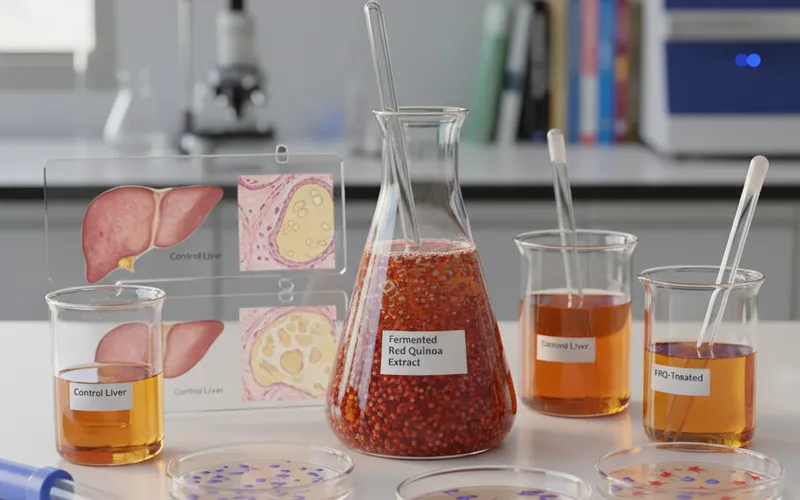
Die Studie – Was wurde untersucht und warum betrifft dich das?
Stell dir vor, du könntest die schädlichen Auswirkungen von Alkohol auf deinen Körper mildern, indem du ein bestimmtes Lebensmittel isst. Eine faszinierende Vorstellung, oder? Genau dieser Frage ist ein Forschungsteam aus Shanghai nachgegangen und hat dabei fermentierten roten Quinoa (FRQ) genauer unter die Lupe genommen. Chronischer Alkoholkonsum ist bekannt dafür, dass er dem Körper auf vielfältige Weise schadet: Er führt zu oxidativem Stress, Entzündungen und einem Ungleichgewicht der Darmflora. Besonders betroffen sind dabei oft das Gehirn und die Leber. Die Forschenden wollten wissen, ob FRQ hier eine schützende Rolle spielen könnte.
Die Studie wurde von einem Team um Lin ZH, Wang Z und Wei F an der Shanghai Jiao Tong University in China durchgeführt und kürzlich im Journal Food Research International publiziert. Sie untersuchten männliche Mäuse der Linie C57BL/6J, die über 28 Tage hinweg in drei Gruppen aufgeteilt wurden: eine normale Kontrollgruppe, eine Gruppe, die Alkohol erhielt, und eine dritte Gruppe, die die gleiche Alkoholmenge zusammen mit FRQ-Pulver bekam. Die verabreichte FRQ-Dosis wurde dabei in eine menschliche Äquivalentdosis von etwa 9 Gramm pro 60 Kilogramm Körpergewicht umgerechnet – eine Menge, die durchaus über die Nahrung aufgenommen werden könnte.
Ein wichtiger Aspekt der Studie war die Fermentation des roten Quinoa. Die Forschenden fermentierten den Quinoa mit Lactobacillus kisonensis und stellten fest, dass dies den Gehalt an nützlichen phenolischen Verbindungen wie Quercetin und Veratrumsäure signifikant erhöhte. Die zentralen Ergebnisse waren vielversprechend: Die Mäuse, die FRQ zusammen mit Alkohol erhielten, zeigten eine verbesserte kognitive Funktion, weniger Schäden an den synaptischen Strukturen im Gehirn, eine stabilere Blut-Hirn-Schranke und eine reduzierte Fettleber im Vergleich zur reinen Alkoholgruppe. Die Forschenden identifizierten mehrere Mechanismen, die zu diesen schützenden Effekten beitragen könnten: FRQ förderte den Alkoholstoffwechsel, indem es die Aktivität von Alkohol-Dehydrogenase (ADH) und Aldehyd-Dehydrogenase (ALDH) regulierte und so den Acetaldehyd-Spiegel senkte. Zudem modulierte es wichtige Proteine im Gehirn (AP-1, BDNF) und beeinflusste das Gleichgewicht der Neurotransmitter Glutamat und GABA. Ein weiterer entscheidender Pfad war die Regulierung der Darm-Leber-Hirn-Achse durch eine Umgestaltung der Darmmikrobiota – zum Beispiel durch die Anreicherung Butyrat-produzierender Bakterien – und eine Stärkung der Darmbarriere, was die systemische Entzündung reduzierte.
Quelle: Lin ZH, Wang Z, Wei F, Zhu X, Ma J, Wu Y, Chen SM, Song LH (2026). Fermented red quinoa (FRQ) effectively mitigates chronic alcohol-induced cognitive impairment and hepatic steatosis through multi-mechanistic pathways. Food research international (Ottawa, Ont.), 230:118547. PubMed-ID: 41794536
Was heisst das wirklich? – Die kritische Einordnung
Diese Studie liefert spannende Hinweise, aber es ist wichtig, die Ergebnisse richtig einzuordnen. Zunächst einmal handelt es sich um eine Tierstudie an Mäusen. Auch wenn Mäuse wichtige Erkenntnisse liefern können, lassen sich die Ergebnisse nicht eins zu eins auf den Menschen übertragen. Unser Stoffwechsel, unsere Lebensweise und unser Alkoholkonsum sind komplexer. Die verabreichte Alkoholmenge und die Art der Alkoholzufuhr in der Studie sind zudem sehr spezifisch und spiegeln nicht unbedingt das menschliche Trinkverhalten wider.
Die Studie zeigt statistisch signifikante Verbesserungen in den FRQ-Gruppen, aber wie bedeutsam diese für die Gesundheit eines Menschen wären, ist noch unklar. Es wurden zwar «harte» Endpunkte wie kognitive Funktion (gemessen an Verhaltenstests bei Mäusen), Schäden an Synapsen und Leberfett gemessen, aber es bleibt die Frage, ob diese Effekte für den Menschen klinisch relevant wären. Ein verbesserter Laborwert ist das eine, eine spürbare Verbesserung der Lebensqualität das andere.
Ein Pluspunkt der Studie ist die detaillierte Untersuchung der Mechanismen. Das Team hat nicht nur gezeigt, dass FRQ wirkt, sondern auch wie es möglicherweise wirkt, indem es den Alkoholstoffwechsel, Gehirnfunktionen und die Darmgesundheit beeinflusst. Das stärkt die Glaubwürdigkeit der Ergebnisse. Allerdings sind die Effekte multifaktoriell, und es ist schwer zu sagen, welcher Mechanismus der wichtigste ist oder ob alle gleichzeitig wirken müssen.
Denkwerkzeug: Wenn du von einer Studie liest, die an Tieren durchgeführt wurde, frage dich: Wie ähnlich ist dieses Tiermodell meiner eigenen Situation? Welche Unterschiede zwischen Tier und Mensch könnten die Übertragbarkeit der Ergebnisse einschränken?
Der Geist im Körper – Die psychophysiologische Perspektive
Hier kommen wir zu einem Punkt, der in vielen Studien – insbesondere in der Grundlagenforschung – oft übersehen wird: die Rolle der Psyche und der Erwartungshaltung. Auch wenn es sich um eine Tierstudie handelt, können wir die psychophysiologischen Prinzipien anwenden, um die Ergebnisse noch tiefgehender zu betrachten.
Die Mäuse erhielten eine bestimmte Nahrungsergänzung. Bei Tieren gibt es zwar keinen bewussten Placebo-Effekt im menschlichen Sinne, aber die Umgebung, die Fütterung und die Handhabung durch die Forschenden können das Verhalten und die Physiologie der Tiere beeinflussen (ähnlich dem Hawthorne-Effekt). Bei Menschen wäre die Erwartung, dass ein «gesundes» Nahrungsergänzungsmittel hilft, ein starker Faktor. Allein die Überzeugung, etwas Gutes für sich zu tun, kann messbare physiologische Veränderungen hervorrufen, die sich dann mit den direkten Effekten des Quinoa überlagern.
Gerade bei Alkoholkonsum spielt die psychische Komponente eine enorme Rolle. Stress, Belohnungssysteme, soziale Faktoren und individuelle Bewältigungsstrategien sind eng mit dem Trinkverhalten verknüpft. Die Studie fokussiert auf die biologischen Mechanismen der Alkoholentgiftung und der Schadensbegrenzung, was absolut wichtig ist. Aber sie kann nicht abbilden, wie die psychische Verfassung eines Menschen den Alkoholkonsum beeinflusst und wie ein solches Nahrungsergänzungsmittel in diesen komplexen Kontext passen würde.
Es ist gut denkbar, dass ein Nahrungsergänzungsmittel wie fermentierter roter Quinoa nicht nur durch seine direkten physiologischen Wirkungen hilft, sondern auch indirekt über eine verbesserte Selbstwirksamkeitserwartung oder ein stärkeres Gefühl der Kontrolle über die eigene Gesundheit. Wenn du das Gefühl hast, aktiv etwas Gutes für deinen Körper zu tun, kann das Stress reduzieren und deine allgemeine Resilienz stärken, was wiederum die physiologischen Reaktionen auf Alkohol oder andere Belastungen positiv beeinflussen könnte.
Der grössere Kontext – Einordnung und Abhängigkeiten
Die vorliegende Studie ist ein wichtiges Puzzleteil in der Forschung zur Ernährung und ihren Auswirkungen auf die Gesundheit, insbesondere im Kontext von Alkoholschäden. Sie bestätigt frühere Erkenntnisse, dass bestimmte Pflanzenstoffe und fermentierte Lebensmittel entzündungshemmende und antioxidative Eigenschaften besitzen können. Die Betonung der Darm-Leber-Hirn-Achse ist dabei besonders modern und relevant, da immer mehr Studien die zentrale Rolle des Darms für die allgemeine Gesundheit hervorheben.
Die Autoren der Studie haben übrigens ausdrücklich erklärt, dass sie keine bekannten finanziellen Interessenkonflikte oder persönlichen Beziehungen haben, die die Arbeit beeinflusst haben könnten. Das ist ein gutes Zeichen für die Objektivität der Forschung.
Was wurde nicht kontrolliert? In einer Tierstudie lassen sich viele Faktoren gut standardisieren. Im menschlichen Leben gibt es jedoch unzählige Variablen, die die Ergebnisse beeinflussen könnten: die genaue Zusammensetzung der Ernährung, das Ausmass des Alkoholkonsums, andere Medikamente, Stresslevel, Schlafqualität und genetische Veranlagung. Eine einzelne Studie kann diese Komplexität nicht abbilden. Ihre Stärke liegt darin, spezifische Mechanismen unter kontrollierten Bedingungen zu untersuchen.
Denkwerkzeug: Bevor du aufgrund einer einzelnen Studie dein Verhalten änderst, frage dich: Gibt es andere Studien, die diese Ergebnisse bestätigen oder widerlegen? Wie passt diese neue Information in das Gesamtbild meines Wissens über Gesundheit?
Was heisst das für dich? – Fazit und Alltagsrelevanz
Was können wir nun aus dieser spannenden Forschung mitnehmen? Auch wenn es sich um eine Tierstudie handelt, gibt sie uns wertvolle Impulse:
- Quinoa und Fermentation als Power-Duo: Roter Quinoa, insbesondere in fermentierter Form, könnte ein wertvolles Lebensmittel sein, das reich an gesundheitsfördernden Verbindungen ist. Die Fermentation scheint diese positiven Eigenschaften sogar noch zu verstärken. Du könntest überlegen, Quinoa regelmässig in deine Ernährung zu integrieren.
- Darmgesundheit als Schlüssel: Die Studie unterstreicht einmal mehr die zentrale Rolle eines gesunden Darms – und seiner Mikrobiota – für die Funktion von Leber und Gehirn. Lebensmittel, die die Darmflora unterstützen (wie fermentierte Produkte), sind daher ein wichtiger Bestandteil einer ausgewogenen Ernährung.
- Prävention ist der beste Schutz: Die beste Strategie gegen Alkoholschäden bleibt ein verantwortungsvoller und moderater Alkoholkonsum oder der Verzicht darauf. Auch wenn FRQ schützende Effekte zeigen mag, ist es kein Freifahrtschein für exzessives Trinken.
Was solltest du nicht daraus schliessen? Bitte interpretiere diese Studie nicht so, dass du nun bedenkenlos Alkohol trinken kannst, solange du fermentierten roten Quinoa dazu isst. Die Studie untersuchte eine spezifische Dosis und einen spezifischen Kontext an Mäusen. Es ist keine Empfehlung für den menschlichen Alkoholkonsum.
Für wen ist das besonders relevant? Diese Erkenntnisse sind besonders interessant für Menschen, die sich generell für eine darmgesunde Ernährung interessieren und nach Möglichkeiten suchen, ihren Körper ganzheitlich zu unterstützen. Auch für die Forschung, die nach natürlichen Wegen sucht, um die negativen Auswirkungen von Umweltgiften oder Genussmitteln zu mildern, ist dies ein wichtiger Baustein.
Der psychophysiologische Gedanke zum Schluss: Denk daran, dass dein Körper nicht nur auf das reagiert, was du isst und trinkst, sondern auch auf das, was du denkst und fühlst. Ein gesunder Lebensstil umfasst nicht nur die Ernährung, sondern auch Stressmanagement, ausreichend Schlaf und eine positive Lebenseinstellung. All diese Faktoren wirken zusammen und beeinflussen, wie dein Körper auf Herausforderungen reagiert – sei es Alkohol oder der tägliche Stress des Lebens.
Diese Studie erinnert uns daran, wie komplex die Zusammenhänge in unserem Körper sind und wie viel Potenzial in natürlichen Lebensmitteln stecken kann. Bleib neugierig, höre auf deinen Körper und integriere Wissen mit Bedacht in dein Leben. Es gibt noch so viel zu entdecken!