Nachts essen und das Krebsrisiko: Eine psychophysiologische Betrachtung
Eine neue Übersichtsarbeit beleuchtet den Zusammenhang zwischen spätem Essen, Darmmikrobiom und dem Risiko für früh einsetzenden Krebs. Was bedeutet das für deine Gesundheit und wie spielt deine Psyche dabei mit?
Die Studie – Was wurde untersucht und warum betrifft dich das?
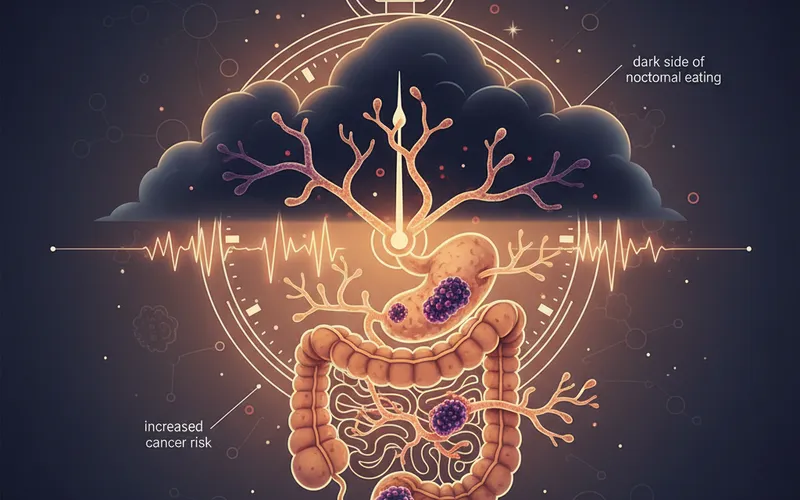
Stell dir vor, du kommst spät nach Hause, der Magen knurrt. Nach einem langen Tag greifst du zu etwas Essbarem, vielleicht noch schnell vor dem Schlafengehen. Viele von uns kennen das. Doch genau diese nächtliche Mahlzeit könnte weitreichendere Folgen haben, als uns bewusst ist. Eine aktuelle Übersichtsarbeit, die im Fachjournal Nutrition Research veröffentlicht wurde, beleuchtet einen faszinierenden – und potenziell besorgniserregenden – Zusammenhang: Nächtliches Essen, die Gesundheit unseres Darms und das Risiko, an Krebs zu erkranken, insbesondere an früh einsetzendem Krebs.
Die Forschenden um Khan SM vom Karachi Medical and Dental College in Pakistan haben sich in dieser narrativen Übersichtsarbeit zum Ziel gesetzt, die aufkommende Achse zwischen Mahlzeiten-Timing, der Störung des Darmmikrobioms und dem Risiko für früh einsetzenden Krebs zu untersuchen. Angesichts der weltweiten Zunahme von Stoffwechselstörungen und Verdauungssystemkrebs, die bereits in jungen Jahren auftreten, rückt der Lebensstil – und hier insbesondere die Essgewohnheiten – immer stärker in den Fokus. Die Autoren haben dafür die Literatur aus Datenbanken wie PubMed, Scopus, Google Scholar und Elsevier durchforstet, um mechanistische Studien und Schlüsselbefunde aus den Bereichen Chrononutrition, Mikrobiomforschung und Onkologie zusammenzutragen.
Die zentrale Fragestellung war: Wie beeinflusst nächtliches Essen unsere inneren Uhren (Circadiane Rhythmen), unser Darmmikrobiom und letztlich unser Krebsrisiko? Die Ergebnisse legen nahe, dass nächtliches Essen die zentralen und peripheren Uhren des Körpers aus dem Takt bringt, die Expression von sogenannten «Uhr-Genen» verändert und zu einer Dysbiose im Darm führt. Eine solche Dysbiose – ein Ungleichgewicht der Darmbakterien – sowie die daraus resultierenden Entzündungssignale könnten tumorfördernde Signalwege aktivieren. Im Gegensatz dazu scheint ein am Tageslicht ausgerichtetes, zeitlich begrenztes Essen (Time-Restricted Eating, TRE) das Potenzial zu haben, die circadiane Synchronisation wiederherzustellen, die metabolische Resilienz zu verbessern und die Darmgesundheit zu fördern, selbst ohne eine Kalorienrestriktion.
Die Forschenden betonen, dass die Rolle von TRE in der Krebsprävention zwar noch hypothetisch ist, seine Vorteile für die circadianen Rhythmen jedoch weitere Untersuchungen rechtfertigen. Insgesamt sehen sie das Mahlzeiten-Timing als einen modifizierbaren Faktor, der die Stoffwechselgesundheit und möglicherweise die frühe Karzinogenese beeinflusst. Die Ausrichtung des Essverhaltens an den intrinsischen circadianen Rhythmen könnte dazu beitragen, das Krebsrisiko zu mindern und das langfristige Wohlbefinden zu verbessern.
Quelle: Khan SM, Hussain JM, Khan B, Saad A, Mehboob J, Rukh G, Manzoor M, Mughal AW, Kayani A, Baig MA, Khan SRM, Saleem Z, Hashim R (2026). Dark side of nocturnal eating: Unraveling the emerging axis between meal timing, gut microbiota, and early-onset cancer risk. Nutrition research (New York, N.Y.), 148, 1-14. PubMed-ID: 41771203
Was heisst das wirklich? – Die kritische Einordnung
Diese Übersichtsarbeit fasst bestehende Erkenntnisse zusammen und weist auf einen wichtigen Zusammenhang hin. Doch was bedeutet das für dich persönlich? Zuerst einmal: Es handelt sich um eine narrative Übersichtsarbeit, keine Interventionsstudie mit harten Endpunkten. Das heisst, die Autoren haben die vorhandene Literatur gesichtet und interpretiert, anstatt selbst neue Daten zu erheben. Das ist eine wichtige Leistung, denn es hilft, den aktuellen Forschungsstand zu überblicken. Allerdings liefert eine solche Arbeit keine neuen, direkten Beweise für Ursache und Wirkung. Die Ergebnisse sind eher als Hypothesen zu verstehen, die durch weitere, gut konzipierte Studien – idealerweise randomisierte kontrollierte Studien mit Langzeitbeobachtung – untermauert werden müssen.
Die Studie spricht von «früh einsetzendem Krebs» und «erhöhtem Risiko». Das ist wichtig zu verstehen: Ein erhöhtes Risiko bedeutet nicht, dass jeder, der nachts isst, automatisch Krebs bekommt. Es bedeutet, dass statistisch gesehen die Wahrscheinlichkeit bei dieser Gruppe höher sein könnte. Grosse Studien liefern oft Durchschnittswerte, aber du bist kein Durchschnitt. Dein individuelles Risiko hängt von unzähligen Faktoren ab, darunter Genetik, gesamter Lebensstil, Umwelt und natürlich auch deine psychische Verfassung.
Ein starker Punkt der Studie ist die Betonung der circadianen Rhythmen und des Darmmikrobioms. Beide Bereiche werden in der modernen Forschung zunehmend als Schlüssel zur Gesundheit erkannt. Die Vorstellung, dass nächtliches Essen diese komplexen Systeme stören kann, ist plausibel und wird durch eine wachsende Zahl von Studien gestützt. Allerdings wurden hier keine harten klinischen Endpunkte wie die tatsächliche Krebsinzidenz gemessen, sondern eher die Mechanismen diskutiert, die zu einem erhöhten Risiko führen könnten. Die positiven Effekte von Time-Restricted Eating (TRE) werden ebenfalls hervorgehoben, doch auch hier ist die direkte Übertragung auf die Krebsprävention noch spekulativ.
Denkwerkzeug: Wenn du diese Studie liest, frage dich: Wie oft esse ich wirklich spät abends oder nachts? Ist das die Ausnahme oder eher die Regel in meinem Alltag? Und welche anderen Faktoren könnten bei mir eine Rolle spielen, die hier nicht direkt angesprochen wurden?
Der Geist im Körper – Die psychophysiologische Perspektive
Hier kommen wir zum Kern dessen, was Jürg Hösli auf seiner Plattform immer wieder betont: Psyche und Körper sind untrennbar miteinander verbunden. Wenn die Studie von «nächtlichem Essen» spricht, müssen wir uns fragen: Warum essen Menschen nachts? Oft sind es nicht nur Hunger oder Bequemlichkeit. Stress, emotionale Belastung, Langeweile, Gewohnheit oder auch Schlafstörungen können starke Treiber für nächtliche Mahlzeiten sein.
Stell dir vor, du bist gestresst, weil du einen wichtigen Termin am nächsten Tag hast oder dich Sorgen plagen. Dein Körper schüttet Stresshormone aus, dein Cortisolspiegel ist erhöht. Das kann das Hungergefühl verstärken, insbesondere auf energiereiche, oft ungesunde Lebensmittel. Gleichzeitig ist dein Verdauungssystem in einem «Kampf-oder-Flucht»-Modus, statt im «Ruhe-und-Verdauungs»-Modus zu sein. Das nächtliche Essen, das oft als Trost oder Ablenkung dient, wird dann zu einer doppelten Belastung: physiologisch durch die späte Nahrungsaufnahme und psychologisch durch den zugrunde liegenden Stress, der die Wahl der Lebensmittel und die Art des Essens beeinflusst.
Der psychophysiologische Aspekt geht aber noch weiter. Die Studie erwähnt, dass nächtliches Essen die circadianen Rhythmen stört. Chronischer Stress ist ein bekannter Störfaktor für diese inneren Uhren. Wer chronisch gestresst ist, hat oft einen gestörten Schlaf-Wach-Rhythmus, was wiederum das Essverhalten beeinflusst und die Wahrscheinlichkeit erhöht, nachts zu essen. Dieser Teufelskreis kann die Darmgesundheit zusätzlich beeinträchtigen. Die Darm-Hirn-Achse ist dabei ein entscheidender Vermittler: Stress verändert das Darmmikrobiom, und ein gestörtes Mikrobiom kann wiederum Entzündungsprozesse fördern und die Signalübertragung zum Gehirn beeinflussen, was sich auf Stimmung, Schlaf und sogar die Entscheidungsfindung beim Essen auswirkt.
Es ist gut denkbar, dass nicht nur das nächtliche Essen an sich das Problem ist, sondern auch die zugrunde liegenden psychischen Faktoren, die zu diesem Essverhalten führen. Wer aus emotionalen Gründen nachts isst, erlebt möglicherweise auch mehr Entzündungen und eine höhere Belastung für den Körper, als jemand, der aus einem anderen Grund eine Mahlzeit verschiebt. Die Überzeugung, dass spätes Essen schädlich ist (Nocebo-Effekt), könnte ebenfalls eine Rolle spielen, indem sie zusätzlichen Stress erzeugt und die physiologische Reaktion auf die Mahlzeit negativ beeinflusst.
Der grössere Kontext – Einordnung und Abhängigkeiten
Diese Übersichtsarbeit reiht sich ein in eine wachsende Zahl von Studien, die die Bedeutung des Timings von Mahlzeiten für unsere Gesundheit hervorheben. Die Chrononutrition – also die Wissenschaft, die sich mit dem Einfluss des Zeitpunkts der Nahrungsaufnahme auf die Gesundheit befasst – ist ein relativ junges, aber dynamisches Forschungsfeld. Die hier präsentierten Erkenntnisse bestätigen Tendenzen, die bereits in anderen Studien angedeutet wurden: Unsere Biologie ist auf einen Tag-Nacht-Rhythmus eingestellt, und wenn wir diesen Rhythmus durch unser Essverhalten stören, kann das weitreichende Folgen haben.
Es ist wichtig zu erwähnen, dass die Autoren in ihrer Interessenskonflikterklärung angeben, keine Konflikte zu haben. Das erhöht die Glaubwürdigkeit der Studie, da keine externen finanziellen Interessen die Interpretation der Ergebnisse beeinflusst haben dürften.
Was in dieser Studie nicht kontrolliert oder berücksichtigt werden konnte, sind die unzähligen anderen Lebensstilfaktoren, die ebenfalls einen Einfluss auf das Krebsrisiko und die Darmgesundheit haben. Rauchen, Alkoholkonsum, Bewegungsmangel, der allgemeine Ernährungsstil (unabhängig vom Timing), chronischer Stress, Umweltgifte – all das sind Puzzleteile im komplexen Bild der Krebsentstehung. Eine einzelne Studie kann und muss nicht alles abdecken, aber der Leser sollte sich bewusst sein, dass nächtliches Essen nur ein Faktor unter vielen ist. Es ist unwahrscheinlich, dass nächtliches Essen isoliert betrachtet die Hauptursache für früh einsetzenden Krebs ist; vielmehr scheint es ein Faktor zu sein, der im Zusammenspiel mit anderen ungünstigen Lebensstilfaktoren das Risiko erhöhen kann.
Denkwerkzeug: Frage dich: Ist das nächtliche Essen für mich ein isoliertes Problem, oder ist es Teil eines umfassenderen Lebensstils, der möglicherweise weitere Optimierungspotenziale birgt? Sollte ich wegen dieser einen Information sofort mein ganzes Leben umkrempeln, oder ist es eher ein Anstoss, über meine Gewohnheiten nachzudenken und sie sanft anzupassen?
Was heisst das für dich? – Fazit und Alltagsrelevanz
Diese Übersichtsarbeit ist ein wichtiger Reminder dafür, dass unsere Essgewohnheiten nicht nur eine Frage von «was» wir essen, sondern auch «wann» wir essen sind. Hier sind 2–3 konkrete Erkenntnisse, die du daraus ziehen kannst:
- Achte auf dein Mahlzeiten-Timing: Versuche, deine Mahlzeiten an deinen natürlichen Tag-Nacht-Rhythmus anzupassen. Das bedeutet, die Hauptmahlzeiten eher tagsüber zu dir zu nehmen und dem Verdauungssystem nachts eine längere Pause zu gönnen. Das Konzept des Time-Restricted Eating (TRE) – zum Beispiel, indem du alle Mahlzeiten innerhalb eines 8- bis 12-Stunden-Fensters am Tag zu dir nimmst – könnte hier ein sinnvoller Ansatz sein.
- Höre auf die Signale deines Körpers und Geistes: Wenn du oft nachts isst, frage dich, warum das so ist. Ist es echter Hunger oder reagierst du auf Stress, Langeweile oder emotionale Bedürfnisse? Das Erkennen dieser Muster ist der erste Schritt, um sie zu verändern. Vielleicht hilft dir Achtsamkeit beim Essen, oder du entdeckst andere Strategien, um mit Stress umzugehen.
- Unterstütze dein Darmmikrobiom: Ein gesundes Darmmikrobiom ist essenziell. Neben dem Mahlzeiten-Timing kannst du es durch eine ballaststoffreiche Ernährung, fermentierte Lebensmittel und einen achtsamen Umgang mit Antibiotika unterstützen.
Was du daraus NICHT schliessen solltest: Panikmache ist fehl am Platz. Eine einzelne nächtliche Mahlzeit wird dich nicht sofort krank machen. Es geht um langfristige Muster und die kumulative Wirkung über die Zeit. Diese Studie ist ein Hinweis, kein Urteil. Überinterpretiere die Ergebnisse nicht und lass dich nicht unnötig verunsichern.
Diese Erkenntnisse sind besonders relevant für Menschen, die unter chronischem Stress stehen, Schicht arbeiten oder unregelmässige Essgewohnheiten haben. Aber auch für jeden, der bewusst seine Gesundheit optimieren möchte, bietet sie wertvolle Anstösse. Der psychophysiologische Gedanke zum Schluss: Denk daran, dass dein Körper nicht nur auf das reagiert, was du isst und wann du es isst, sondern auch stark darauf, wie du dich fühlst und was du denkst. Stressmanagement, gute Schlafhygiene und eine positive Einstellung sind genauso wichtig wie der Speiseplan. Dein gesamter Lebensstil, inklusive deiner mentalen und emotionalen Verfassung, spielt eine entscheidende Rolle für dein Wohlbefinden.
Es bleibt spannend zu sehen, welche weiteren Erkenntnisse die Forschung in diesem Bereich liefern wird. Die Wissenschaft ist ein fortlaufender Prozess. Bleibe neugierig, beobachte dich selbst und finde heraus, was für dich am besten funktioniert.