Zahnfleischentzündung und Stress: Wie unser Mundmikrobiom auf Druck reagiert
Chronischer Stress kann die Gesundheit deines Zahnfleischs massiv beeinflussen – und zwar über dein Mundmikrobiom. Eine neue Studie enthüllt, wie psychischer Druck Entzündungen im Mundraum fördert und wie Omega-3-Fettsäuren helfen könnten. Erfahre, was das für dich bedeutet.
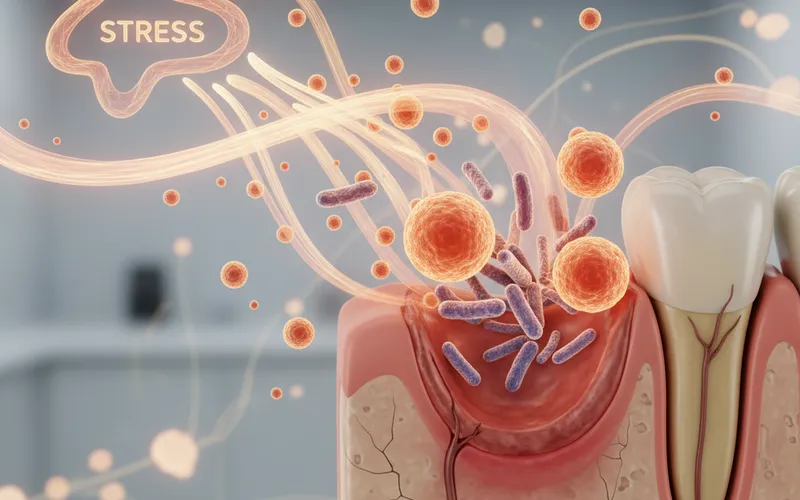
Die Studie – Was wurde untersucht und warum betrifft dich das?
Stell dir vor, du bist ständig unter Strom, rennst von Termin zu Termin, die Sorgen stapeln sich. Dein Kopf raucht, die Schultern sind verspannt. Aber hast du dir jemals überlegt, dass dieser Stress auch direkt in deinem Mund Spuren hinterlassen könnte? Eine brandneue Studie aus China und Neuseeland beleuchtet genau diese faszinierende, aber oft übersehene Verbindung: Wie chronischer psychischer Stress deine Zahnfleischgesundheit beeinflusst – und das auf eine Weise, die viel tiefer geht, als du vielleicht denkst.
Ein Team um S. Luo, F. Lou und P. Yang vom Affiliated Stomatological Hospital der Chongqing Medical University hat untersucht, wie chronischer Stress und Parodontitis (eine schwere Zahnfleischentzündung) miteinander verknüpft sind. Sie wollten herausfinden, welche Rolle dabei unser Mundmikrobiom – also die Gemeinschaft der Mikroorganismen in unserem Mund – und bestimmte Immunzellen spielen. Bisher war diese komplexe Wechselwirkung weitgehend ein Rätsel, doch die Forschenden haben nun entscheidende Puzzleteile zusammengefügt.
Die Studie verwendete ein cleveres Design, das sowohl klinische Beobachtungen am Menschen als auch detaillierte tierexperimentelle Modelle umfasste. Zuerst untersuchten die Wissenschaftler Patientinnen und Patienten und stellten einen signifikanten Zusammenhang zwischen depressiven Symptomen und dem Schweregrad ihrer Parodontitis fest. Dabei zeigte sich, dass Menschen mit depressiven Symptomen ein deutlich verändertes orales Mikrobiom aufwiesen.
Um die Kausalität zu beweisen – also ob der Stress wirklich die Veränderungen im Mikrobiom und die Parodontitis auslöst – führten die Forschenden Experimente mit Mäusen durch. Sie setzten Mäuse chronischem Stress aus (sogenannter Restraint Stress, bei dem die Tiere für eine bestimmte Zeit in ihrer Bewegung eingeschränkt werden) und lösten zusätzlich eine Parodontitis aus. Das entscheidende Experiment war die fäkale Mikrobiota-Transplantation: Sie übertrugen Stuhlproben von gestressten Mäusen auf keimfreie Mäuse. Das Ergebnis war verblüffend: Die keimfreien Mäuse entwickelten ebenfalls eine stärkere Parodontitis, was eindeutig zeigt, dass das durch Stress veränderte Mikrobiom die Krankheit verschlimmern kann.
Auch auf molekularer Ebene gab es spannende Entdeckungen: Die Forschenden stellten fest, dass bei gestressten Mäusen ein wichtiger Stoff, die Eicosapentaensäure (EPA), die zu den Omega-3-Fettsäuren gehört, im Mundmikrobiom deutlich reduziert war. Diese Reduktion von EPA führte dazu, dass Immunzellen, sogenannte Makrophagen, in eine besonders entzündungsfördernde Form (M1-Polarisation) übergingen. Der Clou: Als die Mäuse mit EPA ergänzt wurden, verbesserte sich die Parodontitis, weil die Entzündungsreaktion gehemmt wurde. Diese Erkenntnisse deuten auf eine neue «Darm-Mund-Achse» hin, die durch Stress, Mikrobiota und Stoffwechselprodukte vermittelt wird, und positionieren EPA als vielversprechendes Therapeutikum gegen stressbedingte Entzündungen.
Quelle: Luo S, Lou F, Yang P, Zhang Y, Yan L, Dong Y, Yang B, Wang H, Liu Y, Pu J, Cannon RD, Xie P, Ji P, Jin X (2026). Dysregulation of Oral Microbial Eicosapentaenoic Acid Induced by Chronic Restraint Stress Exacerbates Periodontitis via M1 Macrophage Polarization. Advanced Science, e21346. PubMed-ID: 41783924
Was heisst das wirklich? – Die kritische Einordnung
Diese Studie liefert faszinierende Einblicke, die weit über das hinausgehen, was wir bisher über die Verbindung von Stress und körperlicher Gesundheit wussten. Doch wie immer gilt es, die Ergebnisse genau einzuordnen und nicht vorschnell zu verallgemeinern.
Die Korrelation zwischen depressiven Symptomen und Parodontitis beim Menschen ist ein starker Hinweis, aber eine Korrelation ist noch keine Kausalität. Hier kommen die Tiermodelle ins Spiel. Die fäkale Mikrobiota-Transplantation ist ein elegantes Design, um die kausale Rolle des Mikrobioms zu beweisen. Wenn die Übertragung des Mikrobioms von gestressten auf keimfreie Mäuse ausreicht, um die Krankheit zu verschlimmern, dann ist das ein sehr überzeugendes Argument für die Rolle des Mikrobioms.
Die Studie hat einen klaren Mechanismus identifiziert: Stress verändert das orale Mikrobiom, was zu einem Mangel an EPA führt. Dieser Mangel wiederum fördert eine entzündliche Reaktion der Makrophagen. Das ist ein wichtiger Schritt, um zu verstehen, wie Stress die Parodontitis beeinflusst, und nicht nur, dass er es tut.
Allerdings gibt es auch Grenzen. Die Studie verwendete bei Mäusen ein Modell des «chronischen Restraint Stress». Dieser ist zwar ein bewährtes Tiermodell für psychischen Stress, bildet aber die komplexen und oft subtilen Formen von Stress, die wir Menschen im Alltag erleben, nur bedingt ab. Was bedeutet es für uns, wenn wir von einem Mausmodell auf den Menschen schliessen? Die Ergebnisse sind vielversprechend, aber direkte Übertragbarkeit muss immer mit Vorsicht betrachtet werden. Die klinischen Beobachtungen beim Menschen stützen die Hypothese, aber es braucht weitere Forschung, um die genauen Mechanismen und die Wirksamkeit von EPA beim Menschen zu bestätigen.
Denkwerkzeug: Wenn du selbst unter chronischem Stress stehst und Zahnfleischprobleme hast, frag dich: Könnte mein Stress eine Rolle spielen, auch wenn mein Zahnarzt das vielleicht nicht direkt anspricht? Und was würde es für mich bedeuten, wenn eine einfache Nahrungsergänzung wie EPA einen Unterschied machen könnte?
Der Geist im Körper – Die psychophysiologische Perspektive
Hier zeigt sich einmal mehr die untrennbare Verbindung von Psyche und Körper. Diese Studie ist ein Paradebeispiel dafür, wie psychischer Stress nicht nur «im Kopf» bleibt, sondern sich bis in die entlegensten Winkel unseres Körpers – in diesem Fall unser Mundmikrobiom und unser Zahnfleisch – auswirkt. Das ist keine Metapher, sondern messbare Biologie.
Im psychophysiologischen Interaktionsmodell sind Emotionen, Stress und Erwartungen keine Nebensächlichkeiten. Sie sind mächtige Regulatoren unserer Physiologie. Chronischer Stress aktiviert die Stressachsen im Körper, wie die Hypothalamus-Hypophysen-Nebennierenrinden-Achse (HPA-Achse). Diese Aktivierung führt zur Ausschüttung von Stresshormonen wie Cortisol, die das Immunsystem beeinflussen. Es ist gut denkbar, dass diese Stresshormone direkt oder indirekt die Zusammensetzung und Funktion des oralen Mikrobioms verändern. Ein verändertes Mikrobiom wiederum kann entzündliche Prozesse begünstigen – genau das, was bei der Parodontitis passiert.
Ein Aspekt, der in dieser Studie nicht explizit untersucht wurde, aber im Kontext der psychophysiologie von grosser Bedeutung ist, sind die Erwartungshaltungen. Wenn Menschen unter Stress stehen und das Gefühl haben, ihre Gesundheit sei allgemein angeschlagen, kann allein diese Überzeugung die Anfälligkeit für Krankheiten erhöhen. Umgekehrt könnte das Wissen, dass Stress das Zahnfleisch beeinflusst, Menschen motivieren, ihren Stress besser zu managen, was wiederum positive Auswirkungen auf ihre Mundgesundheit hätte – ein klassischer Placebo-Effekt im besten Sinne.
Diese Studie unterstreicht auch, wie wichtig es ist, den Körper als ein vernetztes System zu betrachten. Die «Darm-Mund-Achse», die hier angedeutet wird, ist ein weiteres Beispiel dafür, dass lokale Probleme oft systemische Ursachen haben, die von unserem psychischen Zustand beeinflusst werden.
Der grössere Kontext – Einordnung und Abhängigkeiten
Die vorliegende Studie fügt sich nahtlos in eine wachsende Forschungslandschaft ein, die die Auswirkungen von psychischem Stress auf das Mikrobiom – sowohl im Darm als auch im Mund – untersucht. Es ist bekannt, dass Stress das Darmmikrobiom stark beeinflussen kann, und diese Studie erweitert unser Verständnis nun explizit auf das orale Mikrobiom und seine Rolle bei Entzündungskrankheiten. Sie bestätigt und erweitert somit frühere Erkenntnisse, die bereits einen Zusammenhang zwischen Stress und Parodontitis nahelegten, indem sie nun einen detaillierten molekularen und mikrobiellen Mechanismus aufzeigt.
Ein wichtiger Aspekt ist die Finanzierung und die beteiligten Institutionen. Die Studie wurde von Forschergruppen in China und Neuseeland durchgeführt und in einem renommierten Journal publiziert. Es gibt keine offensichtlichen Interessenkonflikte, die die Ergebnisse in einem schlechten Licht erscheinen lassen könnten. Das stärkt die Glaubwürdigkeit der Forschungsergebnisse.
Was jedoch nicht kontrolliert werden konnte, sind all die anderen Lebensstilfaktoren, die sowohl den Stresslevel als auch die Mundgesundheit beeinflussen. Ernährungsgewohnheiten, Rauchen, Alkoholkonsum, Schlafqualität, Bewegung – all das spielt eine Rolle. Zwar wurden die Mäuse in kontrollierten Umgebungen gehalten, aber beim Menschen sind diese Faktoren schwer zu isolieren. Die Studie fokussiert auf den Mechanismus von Stress über EPA und Makrophagen, aber im echten Leben ist dies nur ein Teil eines viel komplexeren Bildes.
Denkwerkzeug: Bevor du jetzt sofort eine grosse Menge EPA schluckst, frag dich: Passt diese eine Studie zu dem, was ich bereits über meine eigene Gesundheit und meinen Lebensstil weiss? Gibt es andere Studien, die ähnliche Ergebnisse zeigen, oder ist dies ein erster Hinweis, der noch breiter bestätigt werden muss?
Was heisst das für dich? – Fazit und Alltagsrelevanz
Was kannst du aus diesen spannenden Forschungsergebnissen für dich mitnehmen? Hier sind drei konkrete, umsetzbare Erkenntnisse:
- Nimm deinen Stress ernst – auch für deine Mundgesundheit: Diese Studie zeigt eindrücklich, dass chronischer Stress nicht nur dein Nervenkostüm angreift, sondern auch handfeste Auswirkungen auf deine körperliche Gesundheit hat, bis hin zu Entzündungen im Mund. Stressmanagement ist also nicht nur gut für dein Wohlbefinden, sondern eine aktive Massnahme gegen Parodontitis. Überlege, welche Stressoren du reduzieren kannst und welche Entspannungstechniken dir guttun (Achtsamkeit, Meditation, Sport, etc.).
- Achte auf dein Mikrobiom und Omega-3-Fettsäuren: Die Rolle des Mundmikrobioms und der EPA ist ein Game-Changer. Eine ausgewogene Ernährung, reich an Omega-3-Fettsäuren (z.B. aus fettem Fisch wie Lachs, Makrele oder Leinöl, Chiasamen und Walnüssen), könnte präventiv wirken. Sprich mit deinem Arzt oder Zahnarzt, ob eine Ergänzung mit EPA für dich sinnvoll sein könnte, insbesondere wenn du anfällig für Zahnfleischentzündungen bist oder unter Stress stehst.
- Gesundheit ist ganzheitlich: Diese Studie ist eine weitere Bestätigung, dass Körper und Geist untrennbare Einheiten sind. Dein psychischer Zustand beeinflusst deine Physiologie auf zellulärer Ebene. Wenn du deine Mundgesundheit verbessern willst, reicht es nicht, nur die Zähne zu putzen. Du musst auch auf dein emotionales und mentales Wohlbefinden achten.
Was solltest du NICHT daraus schliessen? Eine einzelne Studie, auch wenn sie vielversprechend ist, ist kein Freifahrtschein für eine Selbstmedikation mit hohen Dosen EPA. Sie ist ein starker Hinweis, aber weitere Studien am Menschen sind nötig, um die optimale Dosierung und Langzeitwirkung zu bestimmen. Konsultiere immer Fachleute, bevor du grundlegende Änderungen an deiner Ernährung oder Supplementierung vornimmst.
Diese Erkenntnisse sind besonders relevant für Menschen, die unter chronischem Stress leiden und gleichzeitig mit wiederkehrenden Zahnfleischentzündungen zu kämpfen haben. Für diejenigen, die keine dieser Probleme haben, ist es eine spannende Information, die das Verständnis der menschlichen Biologie erweitert.
Die Wissenschaft ist ständig in Bewegung, und diese Studie öffnet neue Türen, um die komplexen Wechselwirkungen zwischen unserem Innenleben und unserer körperlichen Verfassung besser zu verstehen. Dein Körper reagiert nicht nur auf das, was du isst oder wie du dich bewegst – sondern auch auf das, was du denkst und fühlst. Bleib neugierig und achtsam mit dir selbst.
Wissenschaftliche Quelle
Advanced science (Weinheim, Baden-Wurttemberg, Germany)